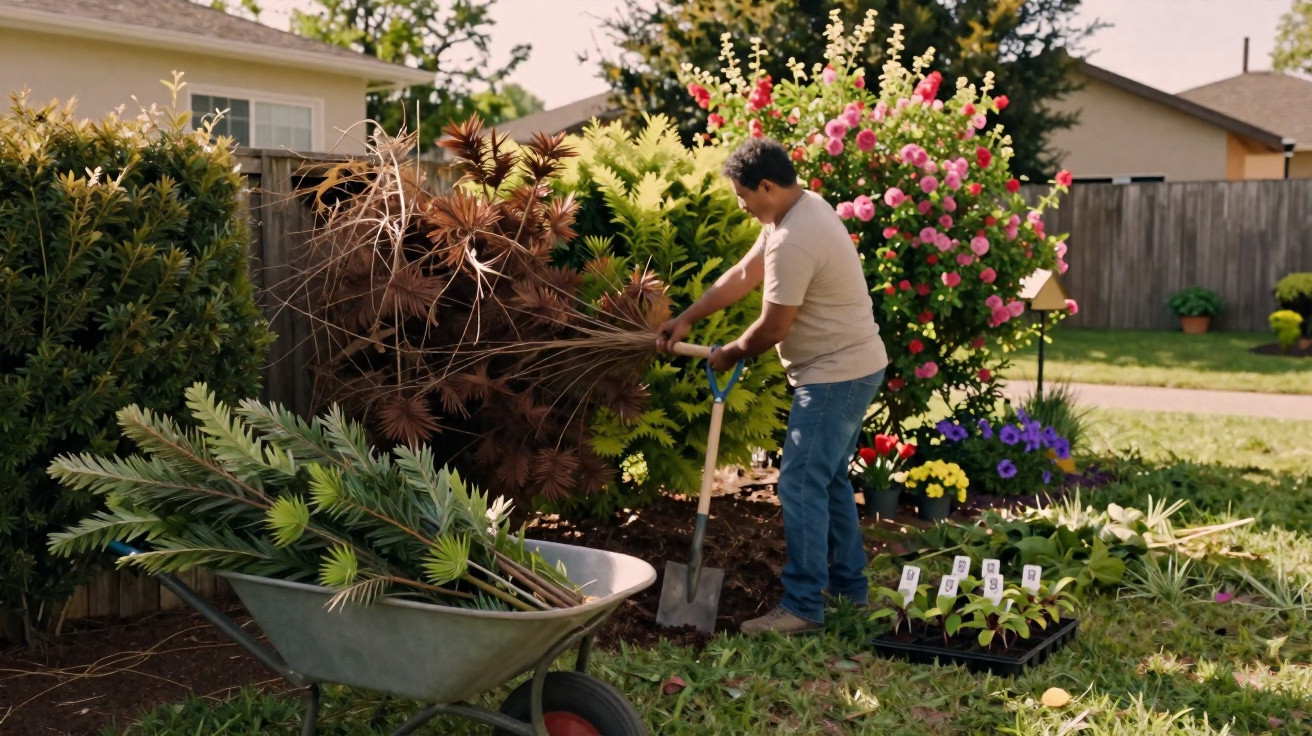
Anyone walking through terraced-house neighbourhoods or older housing estates today can see the signs immediately: gaps in what was once a dense evergreen hedge, large brown patches and dead branches. The much-loved Thuja hedge, long the standard choice for quick privacy screening, is increasingly under strain. Specialists in agronomy and landscape planning agree that this is more than a visual issue: it represents a tangible ecological and practical risk for homeowners.
From garden dream to problem plant: how Thuja became outdated
During the 1980s and 1990s, Thuja was regarded as something close to a miracle plant. It grew quickly, stayed green throughout the year and was easy to shape – ideal for people who “just wanted peace and quiet”. Within a short time, it created a thick green screen while appearing to need very little maintenance.
However, increasingly hot, dry summers are now exposing its drawbacks. Thuja has a very shallow root system. Rather than reaching deep into the soil, its roots remain in the upper layers, which dry out quickly. As a result, the hedge reaches its limits far sooner in dry spells than native shrubs do.
Measurements show that Thuja hedges can use up to around 60 per cent more water than mixed hedges of native species – a genuinely thirsty plant at exactly the wrong time.
Keeping a Thuja hedge healthy during heatwaves requires substantial watering. This pushes up water consumption, creating a real point of conflict in areas affected by water shortages. There is another issue, too: the dense, uniform needles provide almost nothing. There is scarcely any food for insects, little structure for birds, and virtually no flowers or fruit – it may look green, but ecologically it is close to a desert.
Planning rules: why councils no longer want traditional rows of Thuja
Many towns and local authorities are responding. In several areas, development plans and local regulations now contain clear requirements: long, monotonous conifer hedges are being excluded from new-build developments or permitted only under strict limitations.
- Some local authorities ban new Thuja hedges altogether.
- Others impose maximum lengths or area limits.
- In some places, financial support is available for removing old conifer hedges.
Examples from France indicate the direction that German-speaking regions may also take. There, local councils encourage the removal of old Thuja rows and contribute up to around half of the costs of clearance and replanting, provided that a species-rich hedge is planted in its place.
The message is clear: replace the sterile, dark-green “garden fence” with living, mixed planting that provides flowers, fruit and shelter for wildlife.
Stress, beetles and total loss: why Thuja is currently so vulnerable
Climate change affects Thuja hedges in two ways. First, the soil dries out more often and to greater depths. The tree then becomes stressed and releases scents that attract pests. One particularly feared threat is a metallic-looking beetle whose larvae hide beneath the bark and destroy the wood from within.
The result is that the transport channels carrying water and nutrients become riddled with holes. The plant effectively dries out from the inside, even when it is watered generously. The hedge turns brown, becomes brittle and loses its dense growth.
Specialist authorities classify heavily infested Thuja plants as lost – there is virtually no effective treatment for larvae inside the wood.
Leaving such a hedge in place unintentionally creates a constant new supply of pests. The beetles then move on to neighbouring hedges and can also infest other conifers, including certain cypress species. What happens on one property therefore does not remain a private matter; it affects the surrounding area.
Recognising warning signs: when a Thuja hedge really cannot be saved
Not every brown patch means that the hedge has reached the end. Some signs, however, clearly show that pruning will not be enough and that removal is the only option:
| Warning sign | What it indicates |
|---|---|
| Brown areas spreading from the inside outwards | A sign of deeper damage rather than simple sun scorch |
| Dry branches that remain completely brown | Dead sections, with no active buds remaining |
| Obvious tunnels or cavities beneath the bark | Wood-boring larvae are active and the tree is badly damaged |
| No new shoots on older woody sections | Thuja rarely regrows from old wood, so gaps remain permanently |
There is an additional consideration: Thuja does not tolerate severe pruning well. Once it has been cut deeply into old wood, it often produces no replacement growth. The hedge will remain bare in that area. Trying to “save” it through radical cutting can therefore quickly create a patchy, unattractive wall.
The best time to remove Thuja – and when bird protection takes priority
Anyone intending to remove a Thuja hedge should not reach for a chainsaw on a whim. During the bird breeding season, many countries prohibit major pruning and clearance work or place strict limits on it. Broadly speaking, this sensitive period in Central Europe runs from spring to high summer.
Before undertaking major work, it is worth checking the local nature-conservation rules. In many cases, substantial clearance is best postponed until late autumn or winter, when there are no nests in the hedge. If in doubt, inspect it for nests first – and, where necessary, wait a month or two.
After clearance: restoring the soil
Thuja leaves behind more than a visible gap; it also leaves exhausted soil. Over many years, its shallow roots have drawn out water and nutrients, while a thick layer of needles and woody debris often accumulates beneath it.
To give replacement plants the best chance of establishing, several steps are useful:
- Remove stumps and larger root sections as completely as possible.
- Loosen the soil with a spade or cultivator and break up compacted areas.
- Work in mature compost or well-rotted farmyard manure.
- Leave the ground to rest for several weeks so that soil life can recover.
Anyone replanting in the first year should monitor young shrubs particularly carefully during their first summers and water them a little more often at the beginning, until they have developed their own stable root systems.
What can replace Thuja? Hedge plants that benefit the climate and biodiversity
Landscape planners now rarely recommend uniform hedge rows made up of a single species. Instead, they favour mixed hedges or so-called “country” hedges. These combine shrubs of varying heights, sometimes with flowers, berries and colourful foliage.
Popular shrubs for vibrant hedges
- Viburnum tinus (laurustinus) – evergreen, with white flowers, and relatively tolerant of pruning.
- Photinia – striking red young shoots that later become glossy green; highly decorative.
- Privet – semi-evergreen, exceptionally tough and suitable for both formal and informal hedges.
- Hornbeam – often holds its dry leaves until spring, providing privacy even in winter.
- Hazel – flowers early and produces nuts for squirrels and birds.
- Dogwood – depending on the variety, it has red or yellow stems, bringing a splash of colour in winter.
- Hawthorn – thorny, an excellent nesting site for birds, and rich in flowers and fruit.
- Ornamental grasses such as Miscanthus – add movement and structure, particularly in autumn and winter.
These hedges need considerably less water than Thuja monocultures, provide food and shelter for many species, and retain soil moisture more effectively. Measurements show that dense, mixed hedges can keep the ground moist for up to around one third longer in hot weather than a rigid conifer barrier.
Practical advice for switching: keep privacy while improving the garden
Many homeowners hesitate because they fear that removing Thuja will suddenly leave them completely exposed. With a sound plan, this can be avoided:
- In particularly sensitive areas, plant replacement shrubs first and remove the old Thuja the following autumn.
- Use fast-growing species, such as privet, hornbeam and certain Photinia varieties, to create an initial height quickly.
- Combine the planting with a light fence covered in greenery to provide additional privacy during the transition.
- Plant in layers: low shrubs at the front, medium-sized shrubs behind them, and individual taller woody plants at the back.
This avoids creating a sterile “green armour” and instead forms a tiered boundary that makes the garden appear larger. At the same time, insects, birds and other animals benefit from flowers, berries and nesting places.
Why saying goodbye to Thuja is worthwhile despite the effort
Removing an old hedge naturally takes energy, time or money, especially where trunks are thick and rows are long. Over the longer term, though, the change is worthwhile: water demand falls, the risk of sudden total failure disappears, and the garden becomes more alive.
Many people who have already taken this step report noticeable changes after one or two years: more birds, more butterflies and less feeling of heat along the garden boundary. Anyone who has not yet felt ready to take up a spade can begin with a smaller section, gain experience, and gradually replace the entire hedge.
It also gives children a different way to experience the garden. Instead of an anonymous, silent wall, there are shrubs whose flowers can be watched, whose fruit can be collected, and whose appearance changes strikingly through the seasons. The old “green curtain” has had its day – the future belongs to hedges that can do far more than simply block the view.












Comments
No comments yet. Be the first to comment!
Leave a Comment