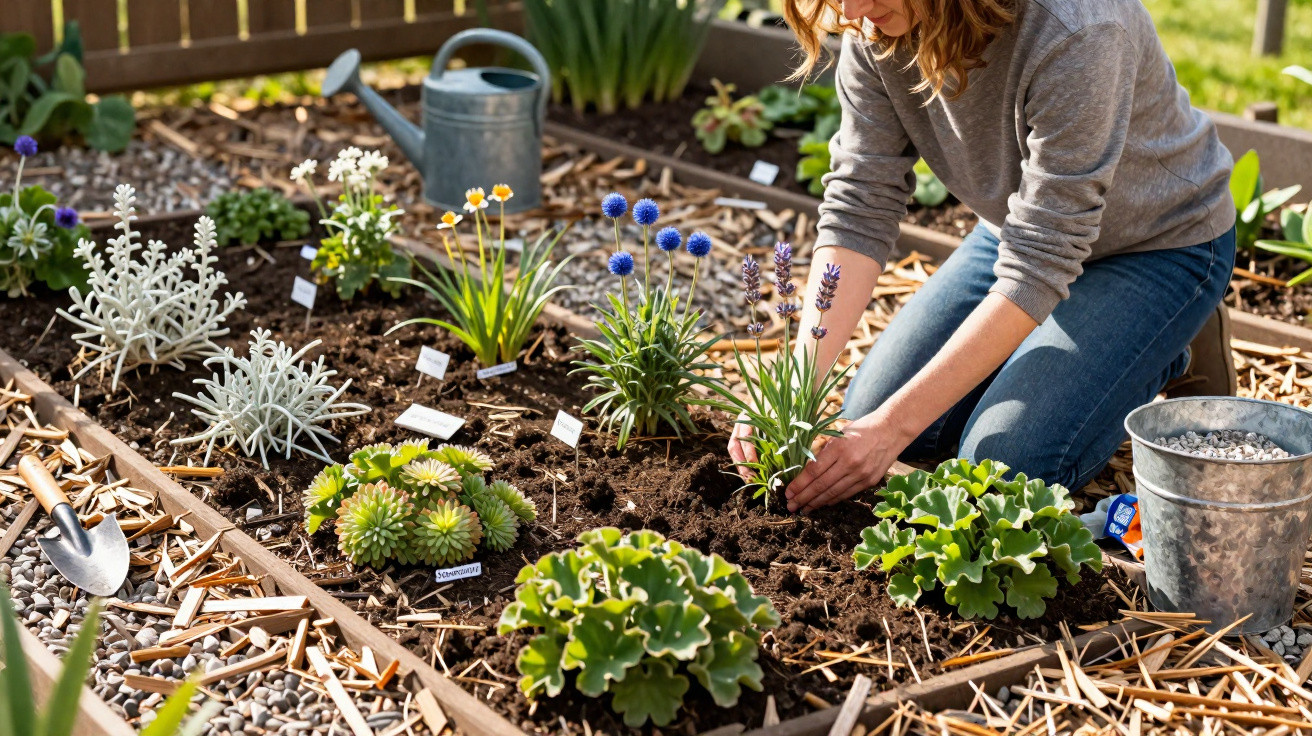
Between hot summers, water shortages and local watering restrictions, amateur gardeners are all in the same boat: the old plan of “plant in May, water in July” no longer works. What matters is what goes into the ground by the end of March – and which perennials can cope with drought rather than wilting at 30 degrees.
Why late March becomes the crucial deadline for your perennial border
The final days of March are far from incidental in the garden; they are the most strategically important period. Plants are emerging from winter dormancy while sap begins to rise through their shoots. The soil is still well supplied with moisture, and the sun is warming without yet being scorching.
Those who plant by 31 March at the latest make use of natural soil moisture and give perennials a head start of weeks in which to establish roots.
This timing determines whether a plant can settle in comfortably in cool, damp soil or must be continually rescued with water like a fugitive from the heat. When spring temperatures rapidly exceed 25 degrees, newly planted perennials face a double burden: transplant shock and added heat. They will then demand plenty of watering.
This is not simply an aesthetic issue but a biological one: a well-rooted perennial border draws water from deeper in the soil. A border planted late, with shallow roots, depends on the garden hose like a patient on a drip.
Five “camel” perennials that cope brilliantly with summer heat
Anyone converting their border to a “summer without compulsory watering” approach should choose resilient long-flowering plants. These five perennials are considered genuine distance runners when it comes to drought.
Perovskia: silvery flower spikes for bone-dry sunny spots
Perovskia, often called Russian sage, is a classic choice for dry borders. Its fine grey-silver foliage loses considerably less water than rich green leaves. It tolerates poor, sandy soil, relishes full sun and even takes short heat spells in its stride.
- Position: Full sun
- Soil: Poor, free-draining and preferably slightly stony
- Advantage: No fertiliser needed and very little maintenance required
Sedum ‘Autumn Joy’: water in the leaves, flowers in late summer
The stonecrop Sedum ‘Autumn Joy’ stores water in its thick, fleshy leaves. It feeds on these reserves through dry weeks, while other perennials have long since begun to droop. Its generous flower heads appear late in the year and attract bees and butterflies well into autumn.
Planting several specimens in groups creates structurally strong cushions that remain interesting in winter, thanks to their dried flower heads.
Gaura lindheimeri: a butterfly-like veil with a deep taproot
Gaura forms a strong taproot, drawing water from deeper soil layers. Its long, delicate flowering stems resemble dancing butterflies, bloom for months and lend an airy feel to the border. Once properly established, Gaura manages with remarkably little water.
A practical example demonstrates the difference: Gaura planted in mid-May often needs water every two days during a hot July. Planted in March, the same plant saves around 200 litres per season.
Echinops ritro: the classic blue globe thistle for poor soil
Echinops ritro, the small globe thistle, thrives where other plants sulk: in dry, chalky soils. Once it has had a year to establish itself, it is regarded as almost indestructible. Its steel-blue spherical flowers make a bold statement and are popular with insects.
Lavender: fragrant protection against drought stress – on one condition
Lavender is almost an automatic inclusion in every dry, sunny border. It withstands heat, drought and wind, provided the soil drains perfectly. If water lingers around its roots for too long in winter, rot becomes a risk. Give lavender a light, gravelly growing medium and it will reward you with fragrance and clouds of flowers.
All five perennials share the same needs: sunshine and soil that allows rainwater to drain away freely. Standing wet causes them more harm than drought.
Hardy geraniums: the wildcard for awkward garden corners
Robust, hardy geraniums – meaning perennial or garden geraniums, rather than the potted plants used on balconies – complement this selection perfectly. They require no frost protection, grow equally well in partial shade or sun, and tolerate a wide range of soils.
For garden “problem areas”, such as beneath woody plants or on slopes, there is almost always a suitable variety. A brief maintenance cut at the end of winter is usually enough: simply strip away dried plant material by hand, and that is all. The perennials reliably produce fresh growth.
The March method: how to plant for a dust-dry-safe border
For perennials to manage on rainwater alone from summer onwards, March planting needs a clear method. Cutting corners at this stage will lead to watering stress later, when a heatwave arrives.
- Water the rootball: Place every container-grown plant in water for around 15 minutes, until no more air bubbles rise. This ensures roots do not begin in dry conditions.
- Make a generous planting hole: It should be at least three times as wide as the pot. Loosen the sides slightly so roots can grow outwards.
- Improve heavy soil: In clay-heavy ground, mix in around 20 per cent gravel or coarse sand. This prevents waterlogging and root rot.
- Water in despite rain: Immediately after planting, give each perennial around 10 litres of water. This settling-in watering ensures close contact between the soil and roots.
- Roughen the rootball: Lightly score the surface of the rootball so roots do not continue growing in the old circular pot pattern.
- Use a mineral mulch: A layer around 7 centimetres deep of grit, gravel or lava granules retains moisture in the soil and prevents surface crusting.
Bark mulch is considerably less suitable for these perennials. While it also retains moisture, it cools the soil greatly and breaks down into a rather heavy, humus-rich layer – precisely the opposite of what sun-loving drought specialists want.
What if March has already passed?
Anyone only reaching for the spade in April does not need to abandon the dream of a garden without watering. Although the ideal planting window does not move, successful planting is still possible with a few compromises.
Perennials planted in April need targeted emergency watering during extended hot spells in their first season. Drainage also becomes more important, because warm spring days dry the soil more quickly. Mineral mulch is particularly useful at this point, keeping heat away from the surface and slowing evaporation.
Planting earlier reduces water requirements; planting later demands discipline: water deliberately, infrequently, but thoroughly.
Example of a drought-resistant perennial border
Those who do not want to spend a long time planning can follow a simple, easy-to-read layout. It creates a low-maintenance border that will not collapse in summer heat:
- Background: Echinops and Perovskia as tall, striking structural plants
- Middle of the border: Gaura and Sedum planted in loose groups
- Front edge: A continuous line of lavender forming a fragrant border
- In between: A few robust garden geraniums to fill gaps and suppress weeds
- Soil: Loosened, improved with sand or gravel, and covered throughout with mineral mulch
With this arrangement, a quick cut-back in late winter is sufficient. Simply cut or pull out the dried flower stems close to ground level, clear away dead material, and the rest takes care of itself.
Why drainage and mulch determine water use
The key to a garden requiring little watering lies not only in plant choice, but above all in the soil. A well-drained foundation allows rain to soak away quickly instead of evaporating at the surface. At the same time, roots can penetrate further down and access a larger reservoir of water.
Mineral mulch works in two ways here: it shields the soil surface from direct sunshine and stops raindrops from washing soil away. The stony layer also creates a microclimate that stores warmth without overheating the root zone. Drought-tolerant perennials grow far more steadily in these conditions.
Anyone setting the course now in spring not only eases the burden on their own watering can, but also on the region’s water reserves. It turns an apparently difficult summer border into an easy-care, long-flowering area that handles heat far more calmly than many people do.












Comments
No comments yet. Be the first to comment!
Leave a Comment