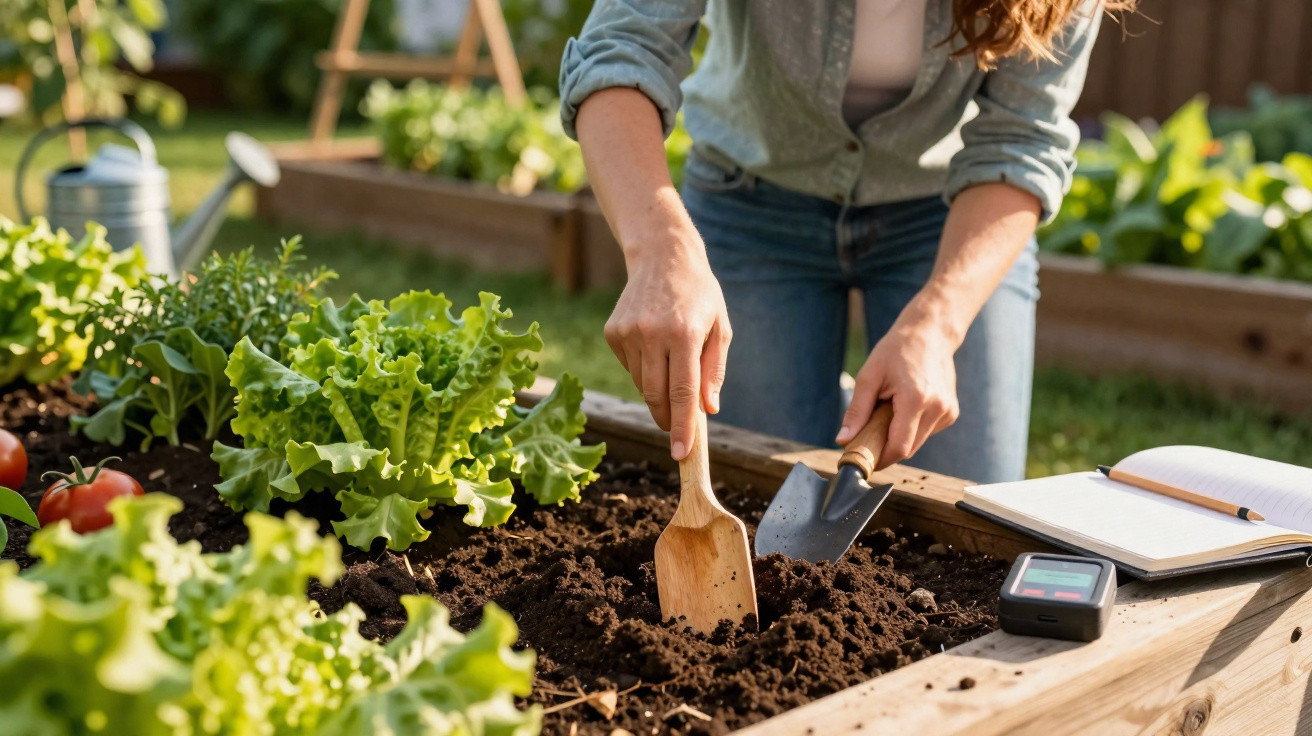
What may look like an odd trend from gardening forums has a highly practical purpose: gardeners use an ordinary wooden spoon to assess how lively their soil is and whether they are watering correctly. It costs virtually nothing, yet provides honest answers-even in situations where expensive measuring devices might otherwise be used.
Why a wooden spoon reveals so much in a garden bed
The principle comes from soil science: wood is organic matter. Bacteria, fungi and earthworms are keen to break down materials of this kind. When an untreated wooden spoon is pushed into the soil, its condition after a period of time indicates how actively this “soil organism” is working.
A damaged, soft and partly eaten-away spoon usually indicates living, fertile soil, while a spoon that is almost untouched is more likely to point to tired, stressed earth.
Gardeners use the spoon for two purposes at once:
- as a test of biological activity in the soil
- as a straightforward moisture indicator in the root zone
It is not a replacement for laboratory testing, but it can give a remarkably clear indication of whether vegetables have the best possible growing conditions-or are merely managing to survive.
Test 1: the wooden spoon as an indicator of soil life
For the “biology check”, the spoon is placed deeper in the ground. The aim is to reach the layers where most roots and micro-organisms are active.
How the soil test works
- Choose an untreated wooden spoon, with no varnish, paint or oil coating.
- Dig a hole around 15 to 20 centimetres deep.
- Insert the spoon fully, then press the soil firmly back into place.
- Mark the position so that it can be found easily later.
- Leave the spoon in the soil for 30 to 60 days.
Once that period has passed, it is time to dig up the spoon and inspect it closely. Every detail matters: cracks, discolouration, soft patches and loose fibres.
| Condition of the spoon | What it says about the soil |
|---|---|
| heavily damaged, fibrous, partly decomposed | very active soil life, many micro-organisms and good humus formation |
| slightly softened, with some feeding marks | sound, living soil with room for further improvement |
| almost like new, hard, with barely any marks | little life; soil is likely to be poor, compacted or worked too frequently |
A completely intact spoon in particular is a warning sign. It often means there is too little organic matter and too few small habitats in which micro-organisms can thrive. Such soils have very often been deeply dug over regularly, heavily walked on, or supplied with nothing but mineral fertiliser for years.
Test 2: using a wooden spoon to check root-zone moisture
The second use is closer to the surface. Here, the gardener uses the spoon as a kind of “wooden sensor” to reveal whether their watering routine matches the actual conditions in the soil.
How to carry out the moisture test
- Use an untreated wooden spoon, again without varnish or paint.
- Push the spoon only about 5 centimetres deep close to the roots, for example between tomato or lettuce plants.
- Leave it in the soil for a week while continuing to water as normal.
- Pull out the spoon and check its surface, colour and smell.
This makes it relatively easy to judge whether the roots are genuinely receiving enough water or are instead being left too dry.
- Spoon is pale, dry and almost clean: The soil is too dry, or water is draining away too quickly. This can indicate insufficient watering, very sandy soil or intense sun exposure.
- Spoon is very dark, heavy and damp: There is probably too much water, prolonged waterlogging and a risk of root rot, especially in sensitive crops such as tomatoes.
- Spoon has mould growth: Conditions are constantly wet, possibly because of a compacted layer with very few air spaces.
A single wooden spoon can show whether plants are being consistently under-watered or over-watered-and it does so exactly where their roots are.
Choosing the right place for the test
Simply pushing the spoon into a dry corner at the edge of a bed will produce a distorted result. The chosen spot should reflect the typical conditions within the bed.
Suitable locations include:
- the middle of a tomato or pepper bed, where watering is frequent
- between rows of lettuce, which responds quickly to dry conditions
- a heavily used bed containing nutrient-hungry crops such as cabbage
Less suitable are places directly beside a path, beneath roof overhangs or in dips where water collects. In those locations, the spoon is more likely to show an extreme situation rather than everyday conditions in the bed.
What you can take from the results
If the spoon is strongly decomposed
A wooden spoon that has been clearly attacked is good news. The soil is active, breaking down organic material and making nutrients available. This fertility can be maintained by:
- applying mature compost regularly
- using grass clippings or leaf mulch to keep the surface covered
- avoiding deep digging and using light hoeing to loosen the soil instead
This keeps the soil stable, improves its water-holding capacity and supplies hungry crops reliably for many years.
If the spoon remains hard and almost undamaged
If the spoon looks like new, it is worth examining the situation more closely:
- Intact and dry: There is little soil life as well as a lack of water. More organic matter, layers of mulch and adjusted watering will help. Green manures with deep-rooting plants can also loosen the soil.
- Intact but damp or slightly mouldy: The soil is wet, poorly aerated and home to few organisms. This is typical of heavy, compacted soils. Repeated applications of compost, handling the spade as gently as possible and, where necessary, improving drainage can help.
Taking such results seriously makes it possible to adjust garden care gradually: rather than watering heavily in isolated bursts, water less often but thoroughly, and do not clear away organic material. Instead, work it into the soil deliberately or leave it in place as mulch.
What the wooden spoon test cannot account for-and what to bear in mind
A wooden spoon can provide a clear picture, but it also responds strongly to external conditions. Cold spells, very dry summers and extended rainy periods all noticeably affect activity in the soil. A spoon buried during a cool April will decompose more slowly than one buried in a warm July.
For this reason, many gardeners repeat the test several times a year or use several spoons in different beds at the same time. This reveals which areas need particular attention and where the system is already working well.
Practical examples from everyday gardening
In sandy soil, the spoon often becomes pale again quickly and remains dry. In this case, it is worthwhile building up a thick mulch layer and adding compost regularly to retain water for longer. In heavy clay soils, by contrast, the spoon is often coated in stubborn, dark soil-a sign that water is draining poorly and air is lacking.
Looking out for further signs at the same time gives a more complete picture: a crumbly structure, dark soil, plenty of earthworms and old roots all point to active soil. Pale, flattened clods, puddles after rain and barely any animal life indicate stress-even if the plants above ground still appear reasonably healthy.
Why this simple wooden spoon test pays off over time
The wooden spoon encourages gardeners to take soil life seriously. Anyone who buries one regularly can see very clearly how their own choices are affecting the soil: after years of compost and mulch, is more wood being broken down than before? Is the earth becoming looser and holding water better?
At the same time, the test helps to correct watering mistakes. Many amateur gardeners water by instinct or according to the calendar. The spoon shows whether that water is actually reaching the roots. This can prevent both dried-out rows of lettuce and soggy tomato roots.
Ultimately, the lesson is simple: anyone willing to sacrifice an ordinary kitchen spoon in a garden bed gains valuable knowledge about their garden soil-and lays the foundations for more reliable harvests, tougher plants and less frustration in dry or wet years.












Comments
No comments yet. Be the first to comment!
Leave a Comment