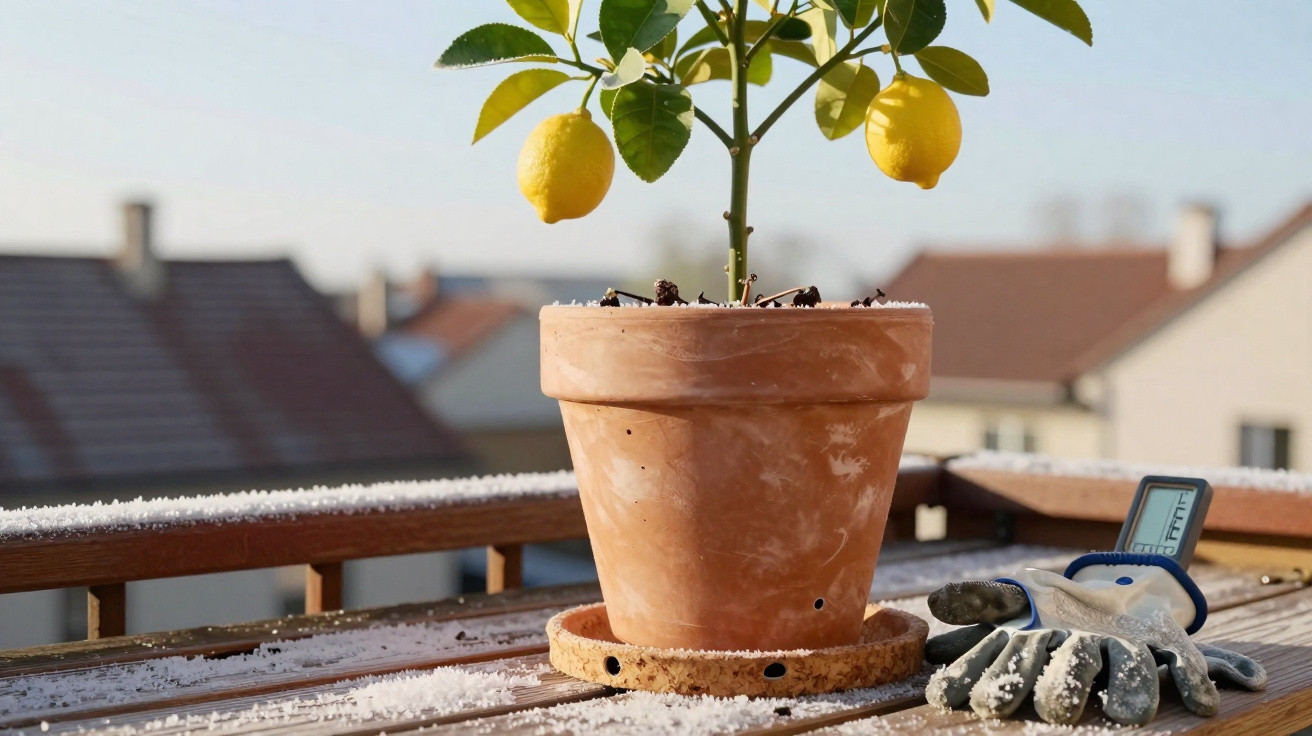
The cause is lurking invisibly beneath the pot.
Anyone who cherishes a lemon tree on a balcony or patio looks forward to fresh green leaves and the first flower buds in spring. Yet this is often when the weather is deceptive: mild days suggest everything is safe, while freezing nights quietly affect the roots. Frost does not arrive only from above; it comes chiefly from below too – and that is exactly where a remarkably simple protective measure helps.
Why March is so risky for potted lemon trees
In February, many container-grown lemon trees still look rather worse for wear, but they begin visibly putting on new growth in March. The sun becomes stronger, daylight hours increase and the tree suddenly appears robust. Many gardeners then put the pot back out on the balcony or patio without concern. Then a clear, cold night strikes.
The crucial issue is that the container usually sits directly on a cold surface, such as concrete, tiles, stone or metal. These materials retain cold and pass it to the base of the pot for hours. The chill travels through the container and reaches the particularly sensitive roots.
“A lemon tree often freezes not because of the air, but through the cold ground – unnoticed in the root area.”
A typical situation is 12 to 15 degrees during the day, a sunny south-facing balcony, a little watering and no apparent cause for concern. Overnight, temperatures briefly drop to minus 2 degrees, perhaps with some wind and a clear sky. The tree may seem protected in a corner, and its trunk can still look normal the following morning – but its roots have suffered cold shock.
The hidden threat: the cold bridge beneath the container
Experts refer to this as a cold bridge. The pot stands directly on a highly conductive material that collects the night's cold and draws it upwards. Concrete floors, stone slabs and tiled balconies act like a cold pack in these conditions.
As a result, the root ball inside the pot cools sharply from underneath, sometimes reaching freezing temperatures. Fine feeder roots, which absorb water and nutrients, are especially vulnerable. Once they die, the tree can no longer receive an adequate supply.
Symptoms frequently do not become apparent until several days later:
- Leaves suddenly become limp even though the compost is not bone-dry
- Young shoots dry out from their tips
- Leaves turn dark, sometimes black
- The tree looks “burnt”, although heat played no part
In many cases, people suspect poor care, such as overwatering, underwatering or unsuitable fertiliser. In reality, it was simply late frost from below that weakened the tree.
The simple solution: an insulating board beneath the pot
The most effective way to prevent this cold bridge is surprisingly straightforward: the container needs an insulating base. In other words, use a board that breaks the direct contact between the pot base and the cold surface.
“An insulating board just a few centimetres beneath the pot can determine whether a lemon tree lives or dies.”
Suitable materials include:
- A rigid polystyrene board, such as expanded polystyrene or insulation foam
- Thick cork, for example from old pot stands
- A wooden board combined with an insulating layer
Two details matter: the board should be about 2 to 5 centimetres thick and extend roughly 1 to 2 centimetres beyond the edge of the pot, so that the whole base is properly insulated. This creates an effective shield against cold entering from underneath.
Keep the drainage hole clear to maintain proper drainage
Frost protection must not obstruct water drainage. Waterlogging is almost as dangerous to lemon roots as frost. A simple approach solves this:
- Cut three corks in half
- Position the halves evenly beneath the base of the pot
- Place the pot, supported by these cork pieces, onto the insulating board
This creates a narrow air gap between the container and the board, keeps the drainage hole unobstructed and allows water to drain away as usual. Together, the board and small cork supports form a double barrier: an air layer and insulating material.
How long the frost protection should stay under the pot
In the UK, the critical period can often last until mid-May, around the traditional mid-May frost period. This can vary slightly by location, but the general rule is:
“The insulating base should remain permanently under the pot until mid-May – day and night.”
It is barely noticeable, does not interfere with watering and can be reused year after year. The board may even remain in place during high summer, especially on very hot stone surfaces. It then prevents the root area from overheating.
Combining protection to keep the lemon tree stable until early summer
The board under the pot provides the foundation. If a pronounced cold spell is forecast, it is worth combining several measures without having to wrap the entire tree.
| Measure | Effect | When is it useful? |
|---|---|---|
| Insulating board beneath the pot | Breaks the cold bridge and protects roots | From late winter to mid-May |
| Fleece over the crown, supported by stakes | Raises temperatures by around 3 degrees in the crown area | When frost nights are forecast |
| Position by a south-facing wall | The wall stores warmth and reduces night-time cold | Always useful for container citrus |
| A “second skin” around the pot, such as bubble wrap or hessian | Provides extra insulation around the root ball | During prolonged cold spells |
Careful watering remains important: before a cold night, the root ball should never be completely saturated. Damp compost conducts cold much better than compost that has dried slightly. A moderately moist, rather than wet, root ball copes better with temperature fluctuations.
How much frost a lemon tree can actually tolerate
Lemon trees are considered frost-sensitive, but a well-protected tree can cope with more short-term cold than many people expect. Healthy specimens can tolerate brief temperatures of around minus 6 to minus 7 degrees, provided their roots and trunk have no direct cold bridge to the ground and the crown has some protection.
A loosely draped winter-protection fleece can provide an additional gain of around three degrees. Combined with an insulated pot base and a warm place against a house wall, this significantly improves the chance of survival, even during unexpected spring cold snaps.
Practical examples: where the insulating board is particularly effective
An insulating board makes the greatest difference in places with pronounced temperature swings:
- South-facing balconies with stone or tiled floors
- Roof terraces with dark flooring
- House entrances with natural stone slabs
- Patios with concrete bases
These surfaces become hot during the day and cool extremely sharply at night. Without protection, the pot sits directly on this temperature rollercoaster. The board acts as a buffer, noticeably reducing these fluctuations.
More benefits: insulation also reduces summer stress
This same measure is useful beyond spring. When midsummer sun beats relentlessly onto a balcony floor and the pot, the root zone in a container can quickly become too warm. Many lemon trees then develop scorched leaf tips or suddenly shed leaves and small fruits.
When the pot stands on an insulating base, the root ball heats up less from below. Combined with a light-coloured rather than black pot, this helps maintain a much more stable root environment. Raising the container slightly as well, for example on small stones or wooden blocks, improves air circulation and prevents mould forming beneath the pot.
Common mistakes and easy ways to avoid them
Many problems affecting container-grown lemon trees can be prevented with just a few simple steps. The most common spring pitfalls are:
- Placing the pot directly onto cold stone slabs
- Protecting only the crown with fleece while leaving the roots unprotected
- Watering too early and too heavily from the end of February
- Fully bringing the tree out of winter protection during mild weather, even though late frosts remain possible
By contrast, placing a simple insulating board underneath, watering moderately and expecting frost nights until mid-May gives a lemon tree a significant advantage. It takes about five minutes, while the reward can be a healthy, fragrant tree covered in flowers and fruit.













Comments
No comments yet. Be the first to comment!
Leave a Comment