The first time floodwater slipped beneath my kitchen door, it did not crash in like a cinematic wave.
It arrived silently and relentlessly, a chilly, creeping spread over the tiles. I still recall the earthy scent - somewhere between cold tea and mud - and the squeal of the rubber squeegee as we attempted to force the water back to wherever it had come from. Once the towels were sodden and my patience had run out, a neighbour sent over a drone image of the hills behind our home. Bare areas marked the slope like scabs. The trees that had once absorbed rain and anchored the soil had been cut back, then cut back again. It takes very little imagination to connect absent roots with a river in flood. The more unusual question keeping me awake was this: could a drone restore the lost forest faster than the next storm reaches us?
When the hillside gives way
A wooded slope has a muted calm during intense rain. Leaves make a soft clicking sound as they take the force out of falling drops, while twigs catch what the trunks miss. Rain landing on needles or broad leaves is slowed, running down in trickles rather than hammering the ground. The forest floor is a system in its own right: fallen leaves and minute insect-made channels work like a sponge with countless tiny openings.
Remove the woodland and that same rainfall becomes harsher. It strikes exposed soil with force, dislodges fine particles and races downhill as though it has somewhere urgent to be. A stream turns into a brown surge, then a river that seems to broaden at the shoulders. This is not spectacular geology. It is simply gravity that is no longer being made to pause.
The quiet maths of floods
Floods are not determined solely by the volume of rain that falls. They also depend on how quickly water can soak into the ground before it rushes towards a river. Forests take time away from storms. Tree canopies can capture a surprisingly large share of rainfall, roots create miniature routes for water to enter the soil, and uneven ground spreads flows into thinner sheets.
Without trunks and stems, there is less interception, less infiltration and less delay. Local flood peaks may arrive sooner and rise higher. That is why a storm that seemed manageable twenty years ago can now feel like a blow to the stomach. The maths may be quiet, but your carpet understands it.
Chainsaws, cattle and cash flow
When people hear “deforestation,” they often imagine illegal logging, yet the causes are more complicated. There may be a new road in one place, grazing pressure in another, a wildfire allowed to smoulder, or a plantation replacing a varied patchwork of native woodland. People require fuel, land and income, and trees can appear to be an easy solution - until the cost arrives downstream.
Let us be truthful: nobody gets up in the morning intending to flood their neighbours. But budgets are constrained, planning periods are brief and, for most of us, the hillside is out of view. Risk builds gradually. We tend to notice only once a swollen river reaches the front step and behaves as if it belongs there.
When floodwater recedes, mud remains
Flooding does not finish when the news crews leave. Slippery silt settles into door frames and dreams alike. Councils face higher drain-clearing costs, water companies must spend more treating grit and nutrients, and salmon lose their gravel spawning beds beneath a burden of hillside soil that should have remained in place. Insurance renewals can begin to feel like a lottery.
That is another reason forests are important. Roots retain more than water: they preserve the story of soil remaining where it should, streams flowing more clearly and birds staying because their food has not been buried. Trees are not a magical defence. They provide thousands of minor delays which, together, amount to mercy.
Planting is beautiful - but too slow
I enjoy a community planting day. There are warm flasks, cold hands and the understated satisfaction of placing a sapling in the ground and pressing down the soil as though finishing a pie crust. The photographs look excellent, as does the feeling. Yet then you hear that one storm and an irresponsible match have burnt 1,000 hectares across the valley, and your 100 saplings abruptly seem like a tick box on the wrong form.
Speed matters now. It cannot be speed for its own sake, but intelligent speed - putting suitable seeds in suitable places, at the right season, with the care needed to give them a chance of survival. This is where the buzz - quite literally, a whirr - of reforestation drones comes in.
Drone reforestation at the speed of weather
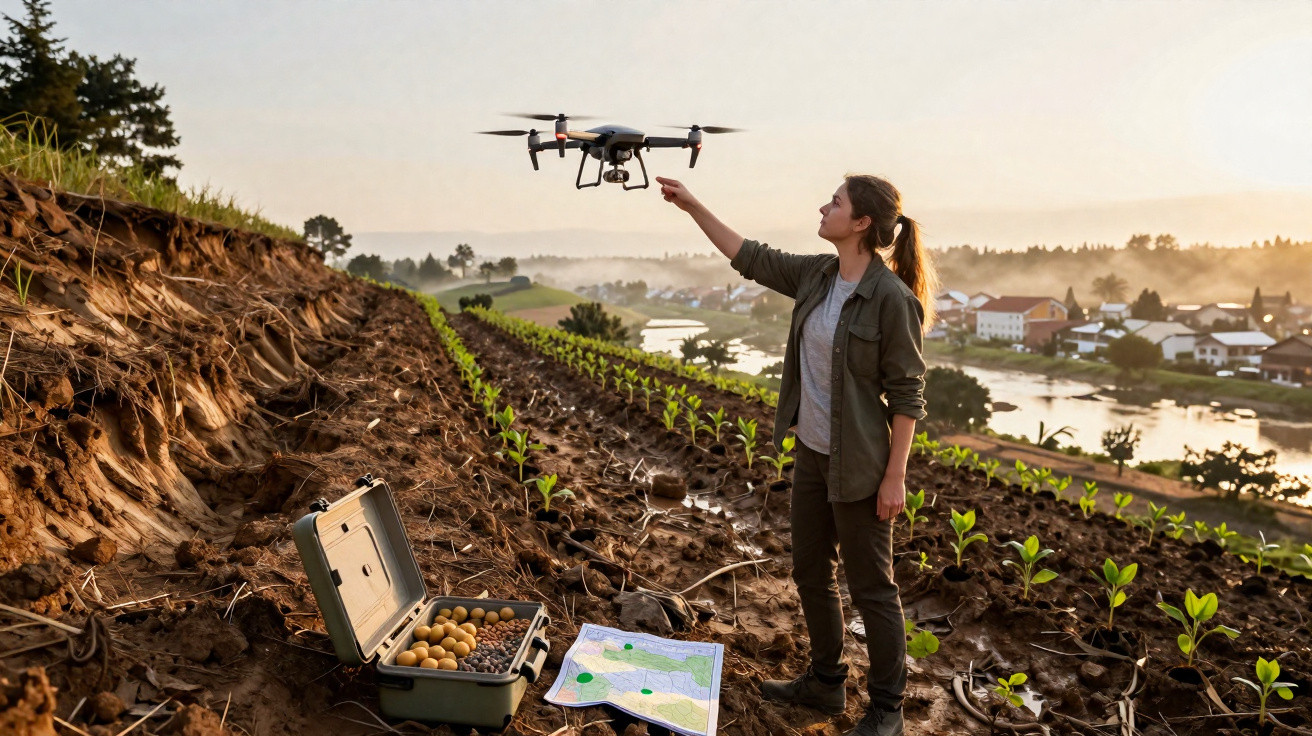
If “drone reforestation” sounds like a gimmick, imagine a small fleet of robust aircraft mapping a hillside in one morning before returning with pods of native seed enclosed in nutrients and protective clay. They fly in grids like methodical bees, releasing pods into tiny hollows where the soil retains a trace of damp and shade. The goal is not to replace people, but to extend what they can do, particularly across difficult and inaccessible terrain where boots would slide and shovels would struggle.
I watched one drone lean into a crosswind, humming like a large but courteous insect, before scattering a damaged slope with a gentle rhythm of possibility. The technology is not science fiction: machine learning helps identify planting locations, lidar interprets the terrain and onboard cameras assess the work. Drones do not plant trees; they plant futures - hundreds of thousands of targeted, tracked seeds, supported by a plan to return and see which ones survive the summer.
What it looks like on the ground
On the day before a drone flight, people assemble seed pods as carefully as if they were making dumplings. There is the gentle compost scent of biochar and a faintly medicinal note from natural pest deterrents. Batteries sit on a trestle table in a row, resembling thick black books. A field team examines maps using traditional pencils, marking exclusion zones around nesting sites and ancient stumps that deserve consideration.
Early schemes reported uneven survival rates. That is improving as teams refine their species combinations and timing. The realistic promise is not perfection but iteration - repeated attempts, rapid feedback and fewer mistakes being made again. Drones excel at scale and speed. They still depend on people who understand a hillside intimately.
Drone reforestation projects you can support now
If your thumb is hovering over a donate button, several teams are worth considering. Dendra Systems, which developed from the former Biocarbon Engineering concept, works alongside landowners and governments and releases case studies containing real survival figures. In Australia, AirSeed combines seed-pod science with local partners who understand how to stop goats and weeds from reversing the work. In North America, DroneSeed, operating under Mast Reforestation, brings together drone planting, seed collection and nursery capacity after wildfires. Canada’s Flash Forest has also concentrated on landscapes after fires, testing approaches for resilient species that are not easily overcome by heat and drought.
Closer to home in the UK, pilot programmes and smaller organisations are trialling drone seeding for riverside corridors and upland gullies, working with bodies such as The Rivers Trust and local wildlife trusts. Technology without communities is merely a briefly popular video. What endures are relationships - with farmers, local councils and the NGOs that remain when batteries are empty and a fence needs repairing.
Support organisations that publish survival data rather than only impressive planting totals. A worthwhile project will explain what survived, what failed and what it changed the following season. If it shares monitoring maps, welcomes independent audits and discusses soils and species, it offers better grounds for confidence than a polished reel alone.
Three quick checks before donating
First, examine the species list. Native mixtures, preferably specific to the region, should be the priority. Extra credit goes to schemes planting beside streams and on slopes, integrating nature-based flood buffers in places where they will genuinely slow water.
Second, seek out community agreements. Are local people paid to gather seed, maintain access and prevent grazing damage? When storms return, a payroll is more useful than a press release.
Third, enquire about monitoring. Are drones or satellites used to confirm growth from season to season? Does anyone walk the site with a clipboard to verify the results on the ground? Trust, then verify. The strongest groups will appreciate the question.
A short guide to who does what
Dendra Systems shares projects across wetlands and drylands, using customised seed pods and AI mapping. AirSeed focuses on biodiversity restoration through seed-to-analytics work in Australia, alongside partners who understand what kangaroos are likely to eat. Mast Reforestation connects drone flights with nurseries and seed banks, creating an unusual cradle-to-canopy model after fire. Flash Forest aims for rapid work across extensive Canadian burn areas while developing towards multi-year care.
There are hybrids as well. Treeconomy in the UK does not operate seed-dispersing drones, but it uses remote sensing to verify forest growth and sells high-integrity credits that can finance planting. Terraformation invests in seed banks and training used by some drone teams when landscapes need rare species. This is a network rather than a story with one hero. That is encouraging. Floods are complicated, and our response ought to be as well.
What drones cannot do
Planting is an opening scene, not the whole film. Seedlings require protection from grazing animals and weeds. Fire breaks are significant. Watering may determine whether there is a green spring or a brown recollection. Land tenure and community support decide whether a young woodland matures or disappears.
Drones cannot negotiate grazing rights. They do not attend a parish meeting to explain why a new fence has appeared on the moor. People do that. A strong drone project comes with a human plan for everything required after the buzzing ends.
What you can do from the kitchen table
Begin with your own catchment. Back a local rivers trust, a beaver reintroduction scheme or a community woodland planting for flood resilience. Ask your council about drone-assisted planting on steep, eroding riverbanks where volunteers cannot work safely. Consider funding the less exciting essentials - long-term monitoring, fencing and seed collection - which form the unglamorous foundation of a forest that survives.
Your money should pay for roots, not press releases. If possible, divide your support between a local project that will invite you to pull weeds in spring and a drone-led initiative working across terrain that people cannot easily reach on foot. This gives you both the modest pleasure of soil under your fingernails and the scale offered by a stream of seeds. Keep some money for emergency funds when floods arrive, because prevention and recovery draw on the same wallet.
Why this is about more than trees
Planting slopes may help keep your phone quiet during storm season, but it also restores places where birds can call out and gives cold-water streams a better chance of remaining clear. Children can grow up remembering the shade of oak trees rather than the outline of sandbags. The economy receives some relief when insurance costs stop rising so sharply.
There is also a collective dignity in repairing what we have damaged. We cannot return to the sawmill’s first cut, but we can choose to create more shade than we remove, and more roots than ruts. Trees do not need speeches from us. They need patience, funding and, at times, our robots.
Small scenes of progress
On a March morning in Yorkshire, a team watches a drone pass over a bare gully that once poured brown water into a beck. Pods drop in quick beats, like taps on a drum. A month afterwards, a volunteer breaks one open between her fingers and smiles at the minute white glimmer of a root. On a burnt slope in British Columbia, a similar hum threads between blackened snags. The air smells of charcoal and wet moss. Hope feels almost visible.
We have all experienced the moment when rain begins and we stare at the ceiling as though the clouds might hear us. Perhaps the next response can be different: checking a project dashboard showing green speckles where none existed before, making a small monthly donation that pays for a row of pods, or sending a quick message to a councillor about a strip of riverbank requiring more than warm words.
The next rainstorm
Storms will continue to arrive. Weather does not negotiate. What can change is how prepared the land beneath us is when the first heavy drops strike the window. Picture a series of drone flights in late autumn, seeding slopes before winter’s tantrums. Picture sheep moved to another field for a season, a fence repaired and a local contractor employed to inspect saplings after the thaw. This is not drama. It is maintenance for a planet that wants to keep us.
Flood resilience is local. It can also be shared. Your hillside helps hold mine together, and mine does the same in return. Drones will not save us by themselves. They can rapidly mend gaps, work where boots cannot and turn an exposed slope into a patient wager on a calmer river. Somewhere, a small machine is taking off with seeds in its belly and a map of our mistakes. I hope it reaches your hillside before your river reaches your hallway.




Comments
No comments yet. Be the first to comment!
Leave a Comment