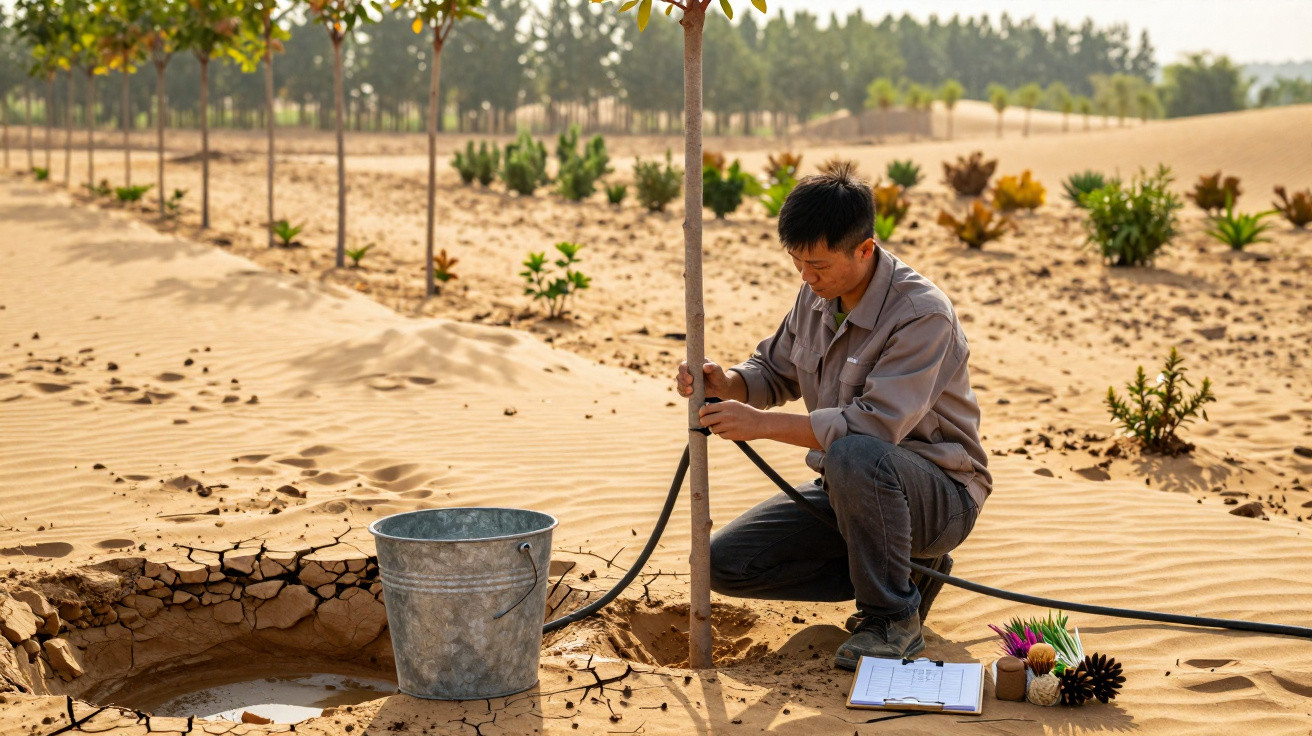
The wind is the first thing you notice: a hot, gritty blast sweeping through northern China, finding its way beneath doors, burning eyes and coating everything from mobile screens to the bottoms of tea cups in fine sand. Along the Gobi Desert’s fringe, young poplars are planted in strict ranks, resembling soldiers in faded green, with plastic wrapped around their trunks to prolong their survival. Residents refer to it as the “green wall”. The government describes it as one of the largest environmental schemes on Earth. Seen from space, it appears victorious: an artificial ribbon of trees holding back a yellow sea of sand. At ground level, the picture is less straightforward. Some trees have already died and others are failing. Wells must be dug deeper every year. The desert does not seem beaten; it seems to be waiting.
China’s billion-tree dream reshaped the horizon
On a hazy spring drive out of Beijing, the landscape gradually emerges beyond the smog: strips of woodland sewn across the steppe, transforming exposed plains into a green patchwork. This is China’s Great Green Wall, an enormous programme begun in the late 1970s and accelerated sharply from the 1990s. Its ambition sounds almost heroic: plant billions of trees, halt desert expansion and shield cities from suffocating sandstorms. Official films show drones passing over immense forests and farmers smiling for the camera. Viewed from a distance, it can seem like a miracle created through determination and organisation. Closer up, however, certain sections resemble a mirage.
During the 2000s, Beijing became well known for “yellow sky days”, as Gobi sandstorms turned the air orange and drove air-pollution readings beyond normal limits. The alarm was genuine. In response, the state invested in tree planting on a scale rarely matched anywhere in the world: satellite information indicates that more than a billion trees were planted in northern China from the 1990s onwards. Whole counties received payments to convert farmland into woodland. Every spring, schoolchildren planted saplings, while local television stations held contests to find the “greenest village”. The headline figures rose quickly. Official reports claimed that forest cover in some areas increased from single figures to more than 20% within only a few decades.
But ecologists walking through these newly created forests began to identify a less visible narrative. Across many locations, quick-growing trees such as poplars and willows were set out in dense, orderly grids with little regard for local soils, rainfall levels or historic patterns of land use. Their survival rates could be extremely poor. Some specialists estimate that, in the driest zones, only a small proportion of trees survive for more than a few years. Yet the scheme still records these sites as “forest” because the trees were planted and mapped. This helps explain why critics describe sections of the vast green belt as an ecological illusion. From the air, there are green pixels; on the ground, the landscape may be brittle, water-hungry and vulnerable.
The hidden costs of water use and monocultures
Farmers in Ningxia and Inner Mongolia offer another perspective. Rapidly growing trees require water, which is already in short supply across northern China. In villages where belts of poplars now cut through former fields, wells that once reached groundwater at 10 or 15 metres may now need to go to 30 metres or more. Some farmers privately say millet and maize harvests declined as the soil lost moisture and tree roots competed for it. Establishing trees in a semi-arid region is not simply an uplifting gesture; it is a gamble over hydration. Each sapling acts like a straw placed in an aquifer that is already shrinking.
The same familiar sequence occurs throughout the region. In spring, officials arrive with lorries carrying identical young trees. The species is selected not for its ability to withstand local conditions, but because it grows quickly, appears green in satellite images and complies with national rules. Workers and villagers spend long days planting straight rows at prescribed distances, then pose with spades for photographs. Afterwards, they return home. Summer arrives, rainfall fails and the trees begin to struggle. Those that survive may create uniform belts consisting of just one species. Such monocultures are exposed to pests, disease and climatic extremes. A single outbreak or one intense year of drought can turn entire strips of the “forest” brown simultaneously.
Scientists maintain that this approach overlooked the underlying causes of land degradation in northern China. Livestock overgrazing, irrigation that consumes vast amounts of water and badly managed cultivation have contributed far more to desertification than the mere absence of trees. You can’t just plant your way out of systemic misuse of soil and water. Concentrating on the number of trunks planted can distract from more difficult remedies: revising grazing rules, reducing groundwater extraction and reconsidering which crops are suitable for dry regions. According to critics, the green wall can sometimes operate as a leafy screen that conceals an uncomfortable truth: people, policy and economics are the real forces driving the advance of sand.
Rebuilding ecosystems instead of simply planting trees
A seemingly simple lesson from China’s decades-long experiment is to plant fewer trees, while choosing the right species, locations and purposes. In several provinces, local authorities have quietly moved away from rigid single-species belts, introducing mixtures of shrubs, native grasses and drought-resistant trees. Shrubs including sea buckthorn, along with native steppe plants, can stabilise soil and retain moisture without consuming enormous amounts of water. They may not look as impressive in satellite pictures as tall poplars, but they can provide more effective living protection against erosion. The most promising initiatives now begin by mapping soils, wind patterns and historic vegetation, rather than merely ordering additional saplings.
There is also increasing support within China for replacing “tree-planting campaigns” with long-term stewardship of the land. That idea may sound admirable on paper, but it encounters ordinary human pressures and habits. People still receive short-term rewards for planting, rather than consistently for caring for trees afterwards. Young residents leave rural communities for employment in cities. It is not easy to keep cattle away from fragile seedlings when grazing land is already limited. We have all experienced the moment when a quick result feels more tempting than a slow repair that requires monitoring, patience and sometimes abandoning familiar routines. Let’s be honest: once the television crews have gone, nobody checks every windbreak every day.
A newer generation of specialists, both in China and abroad, advocates a more modest approach centred on soil. One ecologist based in Beijing stated it plainly:
“Trees are not a wallpaper you roll over the desert. If the ground is sick, the forest will be sick. If the water is gone, the forest will go too.”
They contend that the “green wall” becomes genuine only when it functions as an ecosystem rather than a plantation. This requires protecting tough lichen and moss crusts, restoring wetlands where this is feasible, and making room for native grasses that held the steppe together long before large tree-planting drives started. It also requires confronting difficult compromises:
- Selecting native, slower-growing species rather than fast-growing, thirsty imports
- Permitting controlled grazing instead of abruptly excluding herders
- Accepting uneven, untidy landscapes rather than immaculate green strips
- Funding water-efficient farming instead of drilling deeper wells
- Assessing soil condition and biodiversity, rather than tree totals alone
What China’s “green wall” reveals about us
In a dusty settlement at the desert’s edge, the contradiction is impossible to ignore. Trees do make a difference: they provide shade, reduce the wind and offer evidence of effort against a force that can feel almost cosmic. For those who remember the ferocious sandstorms of the 1980s and 1990s, any greenery is preferable to bare dunes advancing towards their homes. Yet the weaknesses are visible too: dead trunks tilted like white bones, dry irrigation channels and children walking farther to find a working well. This project is neither a simple triumph nor a tidy failure. It is a flawed, living experiment spread across half a continent.
China’s experience has implications well beyond its own borders. From Africa’s Great Green Wall initiative to mass tree-planting campaigns backed by technology billionaires, forests are widely seen as a way to address climate change and desertification. The idea is visual, measurable and inspiring. However, China’s case offers a restrained warning: when “green” is reduced to a spreadsheet figure, when roots are unsuited to rainfall, and when local communities are treated as statistics rather than trusted caretakers, the illusion will eventually break apart. Real resilience is messy, local, and slower than our PR cycles. Trees can play a heroic role, but only as part of an approach that respects soil, water, culture and time. The desert is not merely sand; it also reflects every shortcut taken to reach it.
| Key point | Detail | Value for the reader |
|---|---|---|
| Billion-tree planting can conceal deeper problems | China’s Great Green Wall increased tree cover while often overlooking overgrazing, irrigation and misuse of soil | Helps you see beyond major “green” figures and question what is truly changing on the ground |
| Monoculture forests are vulnerable and water-hungry | Fast-growing poplars and comparable species lower water tables and are easily damaged by drought or disease | Demonstrates why diversity, native plants and water realities matter more than rapid visual improvements |
| Ecosystem restoration is better than simple tree planting | Combining shrubs, grasses, native trees and improved land-management practices creates enduring protection from desertification | Provides a more realistic model for any community or country developing its own “green wall” |
FAQ:
- Question 1 Is China’s Great Green Wall regarded as a success or a failure?
- Question 2 How many trees has China actually planted to combat desertification?
- Question 3 Why do some scientists describe the project as an “ecological illusion”?
- Question 4 What are the principal environmental risks of large-scale tree planting in dry regions?
- Question 5 Which lessons from China’s experience can other countries apply to their own green walls?










Comments
No comments yet. Be the first to comment!
Leave a Comment