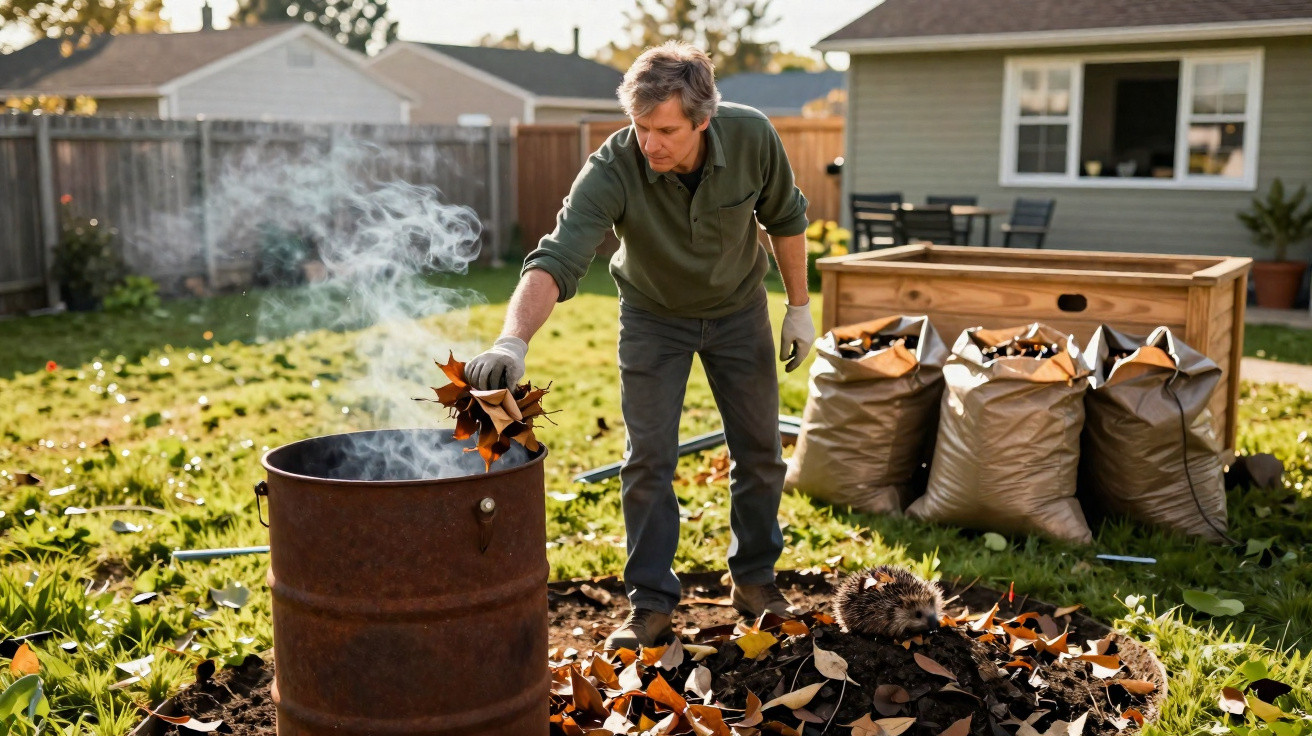
Anyone tidying their flowerbeds in spring can soon end up with piles of leaves, branches and prunings. For a long time, a small garden fire was seen as a convenient answer. However, the rules have changed dramatically – and from April, many local authorities will take enforcement seriously. What may still seem like harmless smoke is, in legal terms, already classed as an illegal waste fire.
What is changing: garden fires allowed only within a narrow time window
The legal position is clearer than many people realise: Germany’s Circular Economy Act generally prohibits the burning of garden waste throughout the country. The fact that fires still burn in some local authority areas does not mean they are quietly tolerated everywhere. Individual federal states, districts and municipalities may permit exemptions – and, in many places, these exemptions are now expiring.
In many municipalities, permission for garden fires ends no later than 31 March; in some areas, it ends a few days later in mid-April – after that, a fine may be imposed.
A typical arrangement works as follows: private garden owners may burn leaves and green waste under certain conditions until 31 March, after which the general prohibition applies again. Some districts allow a slightly longer period, until around 15 April, often subject to set times, minimum distances from neighbouring properties and weather conditions.
Anyone wanting to quickly “get rid of the pile” should therefore check more than the time: they should look at the date and read their local by-law.
Why garden fires are becoming a problem
Authorities have several environmental and health-related reasons for tightening the rules:
- Heavy smoke production: Damp green waste and leaves burn poorly, producing substantial amounts of smoke and fine particulate matter.
- Impact on neighbours: Smoke enters neighbouring homes, irritates airways and can cause symptoms ranging up to asthma attacks.
- Climate-relevant emissions: Burning releases CO₂ and other gases that are harmful to the climate.
- Loss of nutrients: Valuable organic material that could improve the soil is lost permanently.
Particularly in densely built-up residential areas, just a few garden fires can noticeably worsen air quality. Municipalities regularly receive complaints from neighbours who can no longer open their windows or who report watering eyes and coughing. The authorities’ response is stricter requirements or a complete ban.
Saxony-Anhalt example: final opportunity until the end of March
In many municipalities in Saxony-Anhalt, burning remains permitted until 31 March. Anyone who treats themselves to one final “spring fire” after that date is clearly committing an administrative offence. Local by-laws can provide for substantial fines, and these are imposed when neighbours complain or the fire service attends after someone reports smoke.
Importantly, permission never applies automatically across an entire federal state. Every municipality may set its own requirements: garden fires may still be permitted in one village while they have long been completely banned in the neighbouring one. Saying “everyone does it here” offers no protection when the public order office appears at the door.
Mecklenburg-Western Pomerania leads the way: a total ban from 2029
Mecklenburg-Western Pomerania provides a particularly clear indication of the direction of travel. The responsible minister has announced that, from 1 January 2029, burning garden waste there will be completely prohibited. The reasons given are alignment with federal waste law, protection of air and the climate, and returning organic material to the cycle.
In future, garden waste should generally return to the material cycle – as compost, not smoke.
Mecklenburg-Western Pomerania is not an outlier but more of a forerunner. Across Germany, municipalities are tightening their rules, shortening permitted periods or removing exemptions altogether. Anyone relying on their own town “not being too strict about it” is risking their wallet.
How to check what is still permitted where you live
The key rule is not to act on instinct but to check the regulations, as the differences can be considerable.
- Visit the website of your municipality or district.
- Search for terms such as “burning garden waste”, “garden fires” or “disposal of plant waste”.
- Check the period, permitted times and precise conditions.
- If unsure, make a quick call to the public order office or citizens’ advice office.
Many by-laws specify minimum distances from buildings, roads and neighbouring properties, or require that only small quantities of dry plant waste may be burned. Adding household rubbish, old boards or painted wood quickly turns a garden fire into a serious environmental offence.
Legal alternatives: where should leaves and green waste go?
Those who want to be certain of staying within the rules should plan without fire from the outset. There are several useful and lawful ways to deal with garden waste:
| Option | Benefits | Suitable for whom? |
|---|---|---|
| Home composting | Produces free fertiliser, reduces use of the food-waste bin, minimal transport | Homeowners and gardeners with some space |
| Food-waste bin | Straightforward disposal, regular collection, usually reasonably priced | Households in towns and municipalities with a food-waste bin |
| Recycling centre | Accepts larger quantities, often for a small fee or free of charge | Those with substantial hedge or tree cuttings |
| Municipal composting facility | Garden waste is professionally processed, with compost often available to buy back | Gardeners with larger amounts and a trailer |
A home compost heap is especially worthwhile over time: what appears to be waste becomes humus-rich soil conditioner that strengthens beds and lawns in the long term. Material unsuitable for composting, such as thick woody branches, can be shredded and taken to the recycling centre or processed professionally at a composting facility.
How to compost properly
Many garden owners avoid composting because they fear smells or pests. In reality, a properly built compost heap remains clean and odour-free. A few basic principles matter:
- Mix “wet and dry” materials: combine grass cuttings and kitchen scraps with leaves, branches and cardboard.
- Never tip grass cuttings into a heap on their own, as this causes rotting.
- Turn the compost regularly, or at least loosen it, so that air can enter.
- Do not add cooked leftovers, meat or bones, as these attract rats.
Anyone without room for an open compost heap can choose enclosed compost bins. They need little space and can easily be concealed even in terraced-house developments.
What happens if you break the rules? Fines and neighbour disputes
Anyone lighting a fire after an exemption period has expired may face a fine. The amount varies significantly by federal state and municipality. In some areas, minor infringements remain in the two-figure range; elsewhere, several hundred euros may be due if the fire service and public order office attend.
The social consequences can be just as unpleasant: smoke is a reliable cause of neighbourhood disputes. Irritated airways, soot on washing hanging outside and smoke entering bedroom windows can create lasting bad feeling in a residential area – a cost many people underestimate.
What many people do not realise: leaves and dead wood as habitat
Leaves and dead plant material are more than irritating garden leftovers. During autumn and winter, they provide shelter for insects, spiders, amphibians and hedgehogs. If such piles are burned in spring before the animals leave their winter quarters, entire mini-ecosystems go up in flames.
Anyone seeking to garden in a wildlife-friendly way should therefore deliberately leave some leaves in place, for example beneath shrubs or in a quiet corner of the garden. A small pile of dead wood covered with a little leaf litter acts like a winter hotel for many animals, at no extra cost.
Practical examples: how gardeners solve the issue day to day
A simple approach has become established in many terraced-house developments: several neighbours share one large rapid composter or jointly build three open compost heaps. This deals with substantial quantities of leaves and prunings without requiring every individual garden owner to give up a separate corner.
Those who regularly prune trees or tall hedges can also use a shredder. The chopped material fits more easily into food-waste bins and composters, decomposes faster and can also be spread as mulch beneath shrubs. Buying one is often worthwhile through a sharing or hire arrangement: one machine for the entire street, used in turn by everyone.
Why switching approach pays off in the long term
Giving up garden fires may initially seem like an annoying restriction. Over time, however, the new approach brings clear benefits:
- The air stays cleaner, especially for children, older people and those with breathing difficulties.
- Compost and mulch make garden soil more fertile and enable it to retain more water.
- Gardeners save money on fertiliser and soil conditioners.
- Animals gain more shelter and food, increasing biodiversity.
Anyone still planning a fire in March should therefore consider carefully whether the brief flicker is truly worthwhile. In many municipalities, a ban is only days away – and the much better solution is already hidden in the garden itself: the value of what appears to be waste.













Comments
No comments yet. Be the first to comment!
Leave a Comment