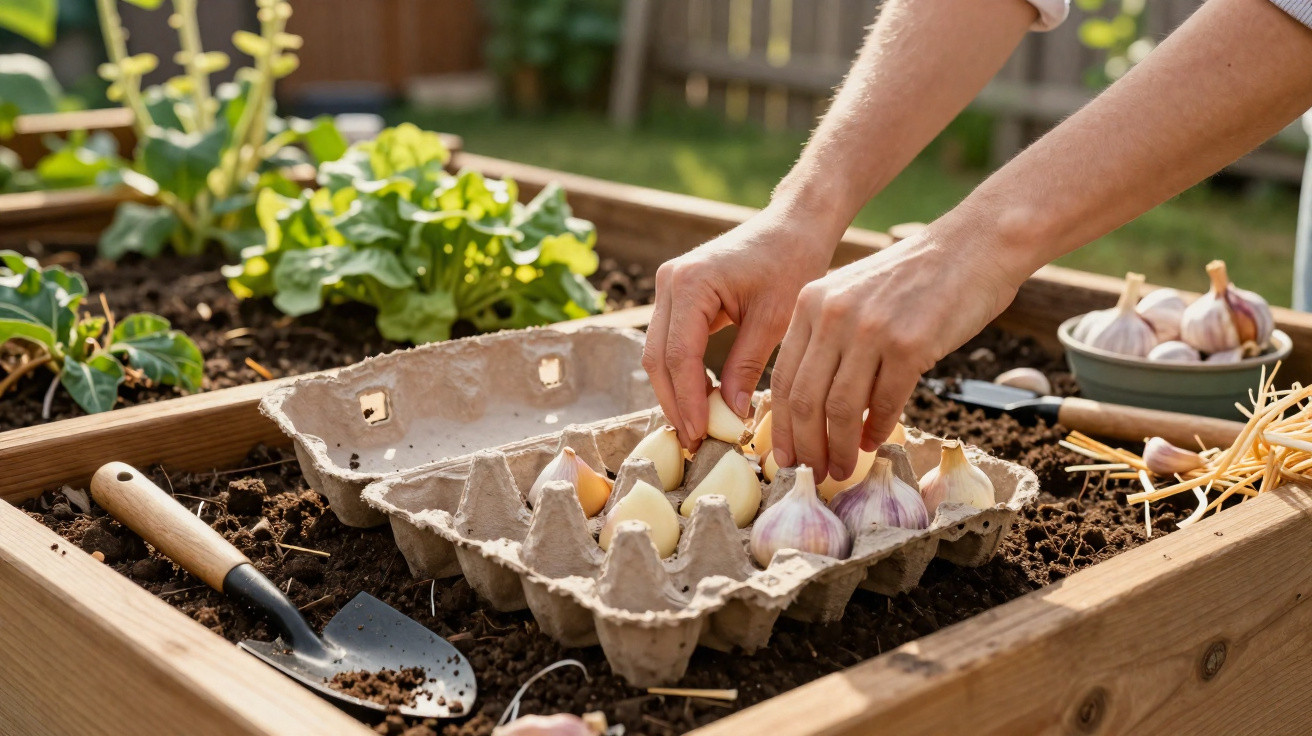
If you love garlic and grow it in your own garden, crooked rows and uneven spacing can soon become frustrating. Usually, this means using a tape measure, planting string, plenty of bending down and a lot of fiddling about. A simple egg carton trick brings order to the bed – saving time, effort and even a little weeding.
How the egg carton trick works for planting garlic
The concept is straightforward: a standard egg carton already has evenly spaced cups. This structure can be used as a planting template, ensuring every garlic clove is automatically placed at the same distance.
The egg carton replaces the tape measure and planting string – its cups set the planting distance, while the carton simply rots down in the soil later.
Step-by-step instructions for the garden bed
For this trick, you only need a prepared bed, a few empty egg cartons and garlic cloves. Here is how to do it:
- Make a straight, shallow trench in the bed, roughly as wide as the egg carton.
- Place the empty egg cartons in the trench, positioning them as closely together as possible.
- Put one garlic clove into each cup, with the pointed end facing upwards.
- Cover with soil, press it down gently and water thoroughly afterwards.
At first, the carton forms a thin layer in the soil. Over time, it breaks down and is decomposed by soil organisms. As a result, the cloves remain exactly where they should be.
Why this trick is so useful
An egg carton addresses several common difficulties when planting garlic:
- Even spacing: Every cup has the same shape, so the cloves are automatically arranged in a grid.
- No slipping: The cloves do not tip over or roll around the bed when soil is added.
- Light weed protection: Initially, the carton surface provides some shade, meaning fewer weeds emerge directly between the plants.
- Improved moisture distribution: Cardboard absorbs water like a sponge and releases it gradually – useful when conditions are slightly dry.
This can save considerable time, particularly for home gardeners planting several rows. Once the cartons have been laid out, planting can be done almost assembly-line style.
The right spacing for strong garlic bulbs
There is more to this trick than neat-looking rows. Garlic needs sufficient room for a single clove to develop into a robust bulb. If plants are too close together, they compete for light, water and nutrients, resulting in small, weak heads.
Gardening recommendations generally suggest:
| Spacing | Recommendation |
|---|---|
| Between cloves | 10–15 centimetres |
| Between rows | 25–30 centimetres |
| Planting depth | 3–5 centimetres |
Many egg cartons have cup spacing that roughly falls within this range. Even if a carton is not ideal down to the centimetre, it provides a tidy layout that works very well in practice.
Those who give garlic enough space will later harvest noticeably larger, more flavoursome bulbs.
Pointed end up, root end down
One detail is often overlooked when planting: the clove's orientation. Garlic has a clear growth direction. Its narrow point must always face upwards, while the wider base faces downwards.
Only in this position can the clove quickly form roots and reliably produce shoots. The egg carton makes correct positioning easier because each clove sits securely in its cup and is less likely to fall over.
Location, soil and timing: getting the most from the egg carton trick
Even ideal planting distances achieve little if the remaining conditions are wrong. A few basic rules help you make the most of your cloves.
Choosing the right spot in the garden
Garlic prefers a bright site with a relatively dry soil surface. Ideal conditions include:
- a sunny position receiving at least six hours of light each day
- loose, crumbly soil without waterlogging
- a bed that was not planted with other alliums in the previous year
Heavy clay soils should be loosened with sand or compost before planting. This allows bulbs to grow more easily and makes them less prone to rotting.
Selecting the right cloves
Not just any leftover cloves from the kitchen are suitable for planting. For healthy plants, choose:
- cloves that are as large and plump as possible
- undamaged bulbs with no soft patches
- dedicated planting garlic from a specialist retailer if diseases have been an issue in the bed
Small, shrivelled cloves often produce only weak plants. It is worth sorting them before planting.
Autumn or spring: when to put the egg carton into the soil
In many gardens, garlic is planted in autumn, usually between September and November. This lets the cloves establish their first roots before winter. The following summer's harvest is generally more abundant as a result.
Spring planting is also possible. If, for example, there was no available space in autumn, you can use the egg carton trick in March or April. The bulbs often remain slightly smaller, but are still perfectly suitable for the kitchen.
How long the carton remains in the ground and what to consider
Cardboard egg cartons from the supermarket gradually break down in the soil over several months. Rain, microorganisms and soil life dismantle the material until almost nothing remains.
However, cartons should not be used without thought:
- Use only uncoated cardboard cartons, not versions with a glossy finish.
- It is better to avoid heavily printed cartons if you are concerned about printing inks.
- Choose cartons without plastic components – in other words, no plastic inserts or films.
For extra peace of mind, tear off the lid and use only the lower section containing the cups. Egg-pulp cartons without heavy colour printing are another suitable option.
More ways to use the egg carton trick in the garden
Garlic is only the beginning. The planting-template principle can also be applied to other crops that tolerate similar spacing.
Possible examples include:
- Onions: Small onion sets sit securely in the cups and do not shift when they are covered.
- Flower bulbs: Crocuses or grape hyacinths can be arranged in decorative rows.
- Lettuce seedlings: In shallower cartons, young plants can be positioned in an orderly way before soil is added.
The carton is less suitable for very deep-rooting or large plants, as the cardboard may initially hinder root development.
Common garlic planting mistakes – and how the trick helps
With or without an egg carton, many home gardeners encounter the same pitfalls. This method eliminates some of them at planting time:
- Too little spacing: The carton automatically sets a limit – it is difficult to plant more closely without damaging the cells.
- Crooked rows: Cartons create a fixed line that can be easily aligned with the edge of the bed.
- Uneven depth: The cups provide a degree of depth guidance, so the cloves sit at a similar level.
One issue remains: if cloves are planted upside down, an egg carton cannot correct it. A quick check before covering them with soil prevents disappointment later.
Why garlic is so popular in the home garden
The effort is worthwhile: home-grown garlic often has a far more intense flavour than much imported supermarket produce. You can select varieties that taste especially mild or particularly pungent, then dry and store the bulbs according to your own needs.
There is also a practical side benefit in the bed: many pests dislike its distinctive smell. Planted among strawberries or roses, garlic can act as a natural companion plant and may keep unwanted visitors partly at bay.
The egg carton trick makes it easier to simply give it a try. A few empty cartons accumulate in almost every household, and one bulb can quickly provide ten or more cloves for planting. Those who start in autumn can look forward in summer to their own evenly grown garlic heads, which can be neatly stacked in crates and bunches.














Comments
No comments yet. Be the first to comment!
Leave a Comment