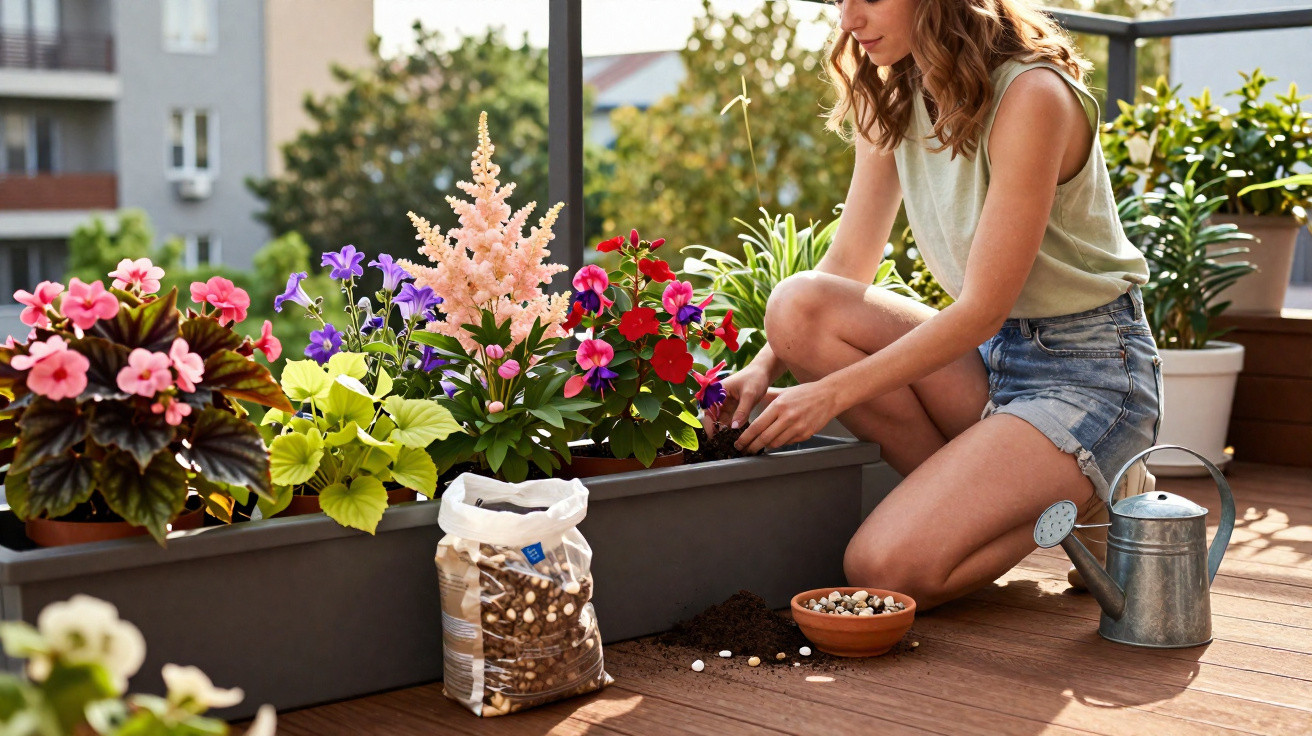
Many amateur gardeners give up on shady corners in frustration. Water lingers there, the soil feels cold, and even tough perennials struggle. Yet, with a few carefully chosen shade flowers, this very weak spot can become a bright focal point from June well into autumn.
Shade is not always the same: assessing the light correctly
Before putting any plant into the ground, take a moment to assess the light. Light shade in the morning has a very different effect from the deep shade beneath an old beech tree.
- Light shade / partial shade: sunshine arrives early in the morning or late in the evening; the area remains bright during the day but receives no direct midday sun.
- Dense shade: beneath trees, beside north-facing walls or in narrow courtyards where sunlight rarely reaches.
Many traditional perennials will still thrive in light shade. Dense shade, however, calls for plants suited to woodland edges or ravines. Light is not the only consideration: the soil dries more slowly, stays cool for longer and can become genuinely heavy if watered too often.
“Anyone planting shade plants should water less, and instead rely on humus-rich soil and leaf or wood mulch.”
A blend of garden soil, well-rotted compost and a loose mulch of leaves or wood chippings creates ideal growing conditions. It keeps roots cool, makes nutrients steadily available and can noticeably extend the flowering period.
These 7 shade flowers bring colour until autumn
For a shade border that flowers for a long time, combine annual plants that bloom continuously with hardy perennials. This provides plenty of interest in the first year, while the perennial framework gradually takes over in the years that follow.
1. Busy Lizzies (Impatiens)
Impatiens are a classic choice for shady balconies. Their name is well earned: from June until the first frost, flowers appear almost without interruption along the stems, provided the soil never dries out.
- ideal for window boxes and containers on north-facing balconies
- prefer consistently moist, but not waterlogged, compost
- cannot tolerate a position in strong midday sun
Regularly removing faded flowers keeps the display dense throughout the summer, creating an almost living carpet of blooms.
2. Tuberous begonias
Tuberous begonias are among the most dependable flowering plants for deep shade. In window boxes, bowls or hanging baskets, they produce large, striking flowers continuously from June to September.
They look especially effective:
- in tall containers or hanging baskets, where their stems can trail elegantly
- in locations without direct sunlight, such as covered loggias
- when grown in loose, humus-rich soil that remains evenly moist
3. Fuchsias
Fuchsias are made for shaded patios. Their dangling bell-shaped flowers resemble tiny lanterns swaying in the breeze until autumn. In mild areas, many varieties continue flowering into October.
They combine particularly well in containers with tuberous begonias: begonias fill the rim of the pot while fuchsias add height. Regular applications of fertiliser for flowering container plants are important, otherwise their flowering performance declines.
4. Astilbes
Astilbes add structure to a border. Depending on the variety, their upright, feathery flower plumes emerge from June to August in white, pink, red or rich purple. They are especially suitable for:
- beds in the light shade beneath trees
- the edges of ponds or streams
- the rear of borders where extra height is needed
Astilbes appreciate moist, humus-rich soil. During hot spells, one or two thorough waterings each week will reward you with reliable flowering.
5. Carpathian bellflower (Campanula carpatica)
In light shade, the Carpathian bellflower produces countless small, star-shaped blooms in white or vivid blue. It often starts flowering as early as May and, if faded flowers are cut back regularly, continues until September.
It is an excellent choice for low edging, the tops of walls or the front of a shaded perennial border.
6. Hardy geraniums for partial shade
Varieties such as ‘Rozanne’ are true long-flowering performers. Loose, trailing stems carry blue-violet blooms from June right through to October. The plants form a dense ground cover that leaves little room for weeds.
Hardy geraniums prefer:
- light shade or partial shade
- relaxed gardens that are not overly formal
- broad plantings where they can show off their carpet-forming habit
7. Foamflowers – the quiet stars beneath trees
Foamflowers resemble Heuchera in their foliage, but are often more delicate and tolerate deeper shade. Their fine white or pink flower spikes float above dense clumps of leaves from April until late summer.
They feel particularly at home in cool, humus-rich soil, for example beneath woody plantings or on north-facing slopes.
Combining shade flowers for a continuously flowering border
A shaded part of the garden benefits from layers: low ground cover at the front, taller perennials behind it, and perhaps the open canopy of shrubs or trees above.
| Area | Suitable plants | Effect |
|---|---|---|
| Foreground | Carpathian bellflower, foamflowers, hardy geraniums | a continuous flowering carpet with very little bare soil visible |
| Middle ground | Astilbes, taller hardy geraniums | colour at eye level and soft transitions |
| Background | Shrubs, small trees, tall astilbe varieties | a backdrop that makes the flowers stand out more strongly |
Under a tree, a pairing of hardy geraniums and foamflowers can cover the ground densely. Add two or three astilbes in different shades of pink behind them, and you will have a long ribbon of colour from early summer into autumn.
“With three layers – ground cover, medium-height perennials and a background – even a tiny shade border can appear surprisingly deep.”
Planting a north-facing balcony cleverly: from problem area to summer display
Balconies generally lack deep soil. Busy Lizzies, tuberous begonias and fuchsias are particularly effective here when planted in boxes and hanging baskets.
- Fuchsias in hanging baskets bring flowers up to eye level.
- Tuberous begonias fill the gaps with strong colour.
- Busy Lizzies close the spaces around the edges.
One practical tip: large containers dry out more slowly and are more forgiving of watering mistakes. Enriching the compost with a little compost and a slow-release fertiliser creates a sound foundation. A thin mulch of bark pieces or coconut fibre also helps retain moisture in the pot.
A low-maintenance routine for months of flowers
Most shade flowers do not need a complicated care schedule; they simply require three consistent basics:
- regular watering rather than infrequent “downpours”
- loose, humus-rich soil that does not become compacted
- regular removal of faded flowers from Impatiens, begonias, fuchsias and bellflowers
Working in a thin layer of compost once each season supplies perennials such as astilbes, foamflowers and hardy geraniums with nutrients almost automatically.
When shade is an advantage – and what to avoid
Shaded areas also have clear benefits: the soil loses moisture more slowly, plants experience less heat stress and many stay fresh for longer. In hot summers, a cool, slightly dim garden corner can feel like its own microclimate.
Waterlogging can become a problem. Rainwater quickly accumulates, especially in containers without drainage holes or in compacted soil. A layer of expanded clay or coarse gravel in pots, or some sand and compost added to the planting hole in the garden, will help prevent this.
It becomes especially interesting when shade flowers are combined with foliage perennials. Hostas, ferns and Heuchera provide structure and eye-catching leaves, while Impatiens, begonias and astilbes supply colour. The result is a display that remains lively at all times, even on days when fewer plants are in flower.













Comments
No comments yet. Be the first to comment!
Leave a Comment