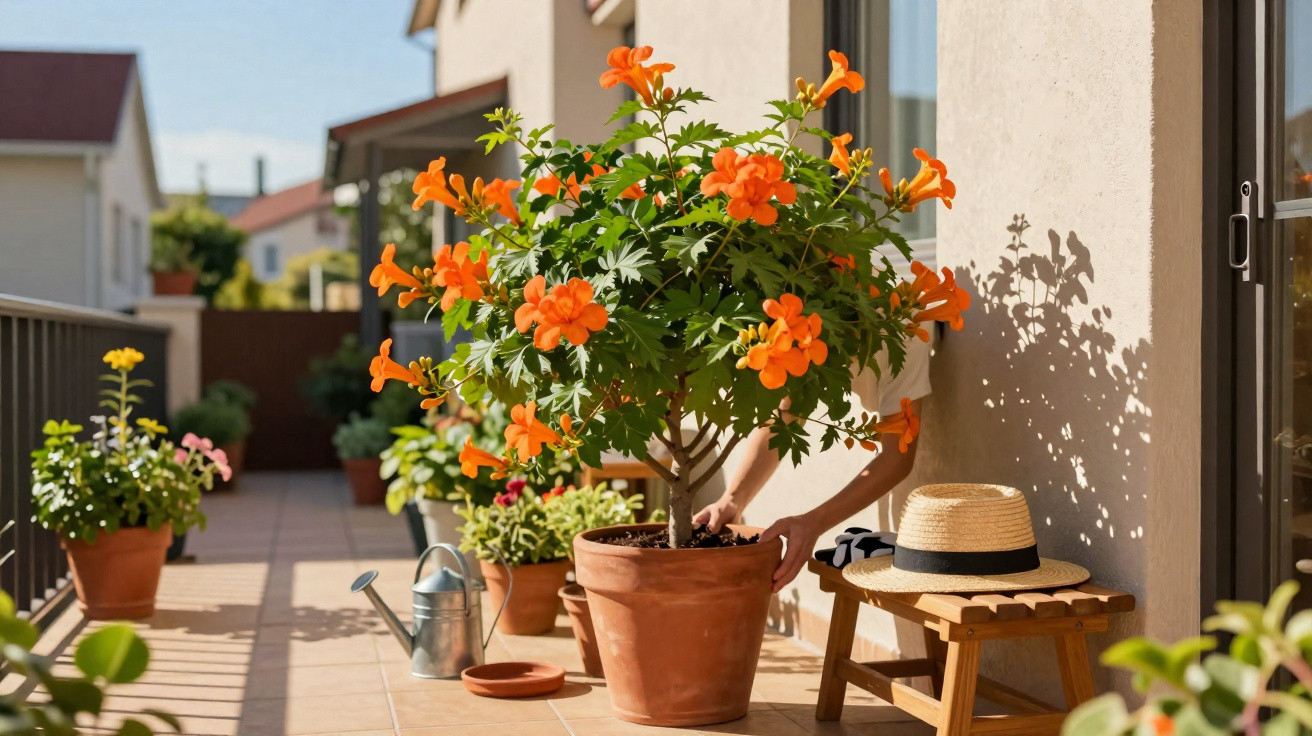
Tiny terrace, narrow front garden or just a few square metres of greenery?
With the right shrub, even a confined spot can feel like a little oasis for months.
Many amateur gardeners know the issue: no sooner has a shrub been planted than, a few years later, it outgrows every boundary. The result is often a reliance on low perennials and seasonal flowers – leaving the garden looking suddenly bare from late summer onwards. A compact, perennial shrub with a long flowering period can make a substantial difference here. Tecomaria ‘Cape Town Orange’, a little-known choice with vivid orange flowers, fits precisely into this gap.
Why this compact shrub transforms small gardens
Tecomaria ‘Cape Town Orange’ is among the shrubs deliberately bred to remain small. It generally grows to only around 1.50 metres tall and approximately 1.80 metres wide. This makes it considerably more delicate than the species Tecomaria capensis, which can quickly exceed two metres in height.
That is a major advantage in restricted spaces. The shrub can be positioned as a focal point without overwhelming everything around it. It is particularly suitable:
- at the edge of a small terrace
- beside a bench or lounge chair
- as a specimen plant at the end of a narrow path
- at the centre of a small perennial border
- in a larger container on a balcony or roof terrace, in mild regions
Its habit resembles a rounded, dense cushion. This adds structure to clean, contemporary garden designs, while working just as well in a slightly untamed urban garden.
The key is the combination of compact growth and months of flowers – a rare mix that is especially effective in small gardens.
Orange trumpet flowers from May well into autumn
Its main display starts in late spring, when Tecomaria produces its first bright, richly orange trumpet-shaped flowers. In mild locations, flowering begins from around May and continues into autumn, often until mid or late October.
The flowers appear in dense clusters at the ends of the shoots, giving the shrub an almost cloud-like appearance from a distance. Closer up, their characteristic trumpet shape becomes clear, recalling other nectar-rich plants from warmer regions.
This extended flowering season prevents the garden from becoming dull during the usual “summer lull” – after spring-flowering plants have finished but before autumn perennials have fully come into their own. This is especially valuable in narrow town gardens and on terraces, where every square metre counts.
From late spring into autumn, the shrub repeatedly produces fresh flower clusters – without the need for constant replanting.
Tecomaria ‘Cape Town Orange’: sun, heat and climate requirements
Tecomaria originally comes from warmer regions. The cultivar ‘Cape Town Orange’ behaves like a tropical yet surprisingly resilient garden plant. In genuinely mild areas, comparable to USDA zones 9 to 11, it can even remain evergreen throughout the year and continue flowering in winter.
In central Europe, much depends on the region. In frost-free wine-growing areas or sheltered urban positions, the shrub can remain in the same place for several years. During harsher winters, the above-ground growth often dies back, but with good winter protection the plant can regrow from the base.
Choosing the right place in the garden
Tecomaria ‘Cape Town Orange’ loves sunshine. A fully sunny position produces the strongest flowering. In very hot areas, however, a few hours of afternoon partial shade can benefit the plant by preventing the foliage from scorching.
The soil can vary, but it should meet the following requirement:
- free-draining, so that waterlogging does not occur















Comments
No comments yet. Be the first to comment!
Leave a Comment