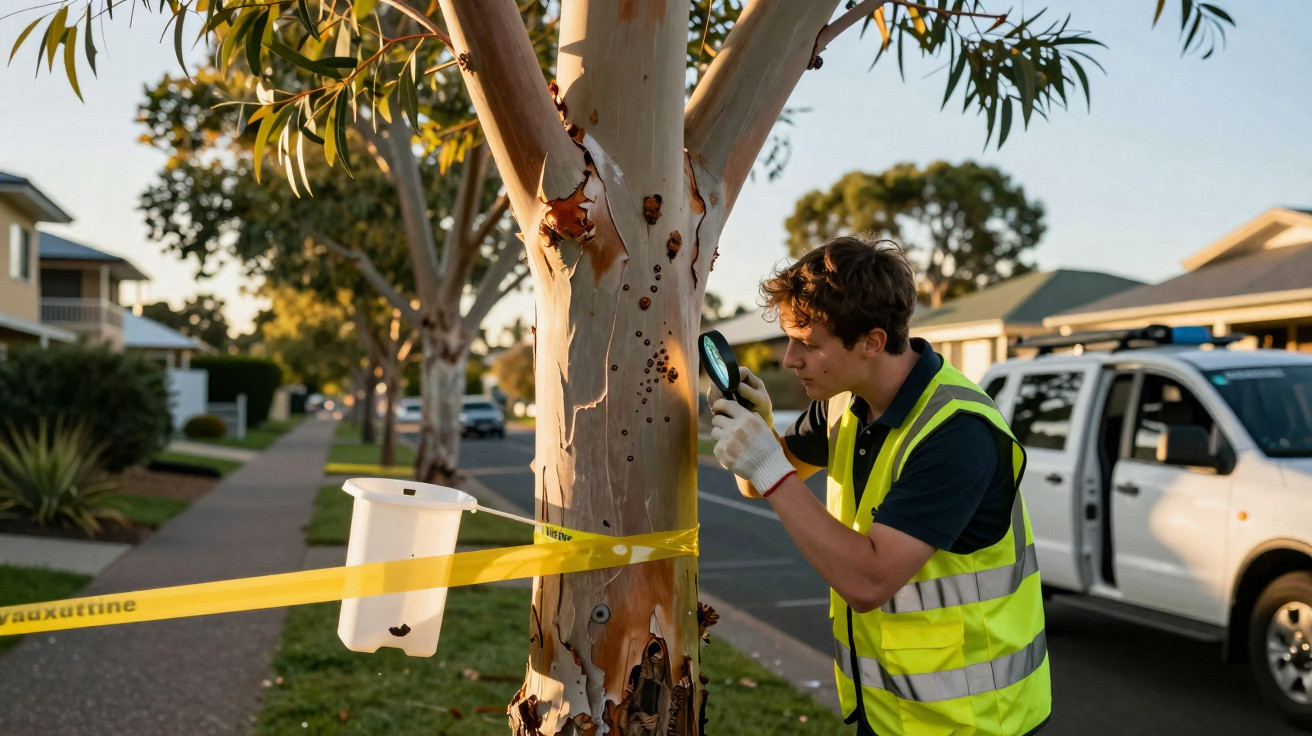
Researchers have determined that extensive areas of Australia have conditions suited to the polyphagous shot-hole borer, a tree-killing beetle that has already destroyed thousands of urban trees in Perth.
The discovery transforms a local outbreak into a national alert: city canopies, orchards and native forests may be at risk well beyond Western Australia.
Perth demonstrates the threat
Bare parks and riverbanks without their usual shade across Perth illustrate the extent of damage since the shot-hole borer beetle became established in mature trees.
Curtin University researchers tracked the pest’s movement through the city’s canopy and confirmed that comparable environmental conditions occur throughout large parts of Australia.
Their findings indicate that the Perth outbreak was not a one-off event, but an early illustration of how the beetle can become established where favourable climates and host trees coincide.
The wider susceptibility highlights how a very small insect can cause extensive tree losses.
How the beetle kills trees
After entering a branch, the polyphagous shot-hole borer – a minute invasive beetle from Southeast Asia that cultivates fungus – does not destroy trees simply by boring into them.
It instead grows a fungus that blocks the tree’s water and nutrient channels, causing branches to become dehydrated, deprived of nutrients and fragile.
State guidance states that the pest has affected more than 500 plant species globally, with more than 100 able to support breeding by both the beetles and the fungus.
This combination of tunnelling and fungal obstruction explains how an insect scarcely larger than a sesame seed can rapidly strip a canopy.
People spread the beetle
On its own, the shot-hole borer beetle travels only limited distances, yet people can unknowingly transport it between suburbs or even across state borders.
Unseasoned firewood, mulch, green waste and woody nursery stock may conceal infested material for long enough to start fresh outbreaks.
New national mapping suggests the beetle may naturally spread by around 2 miles (3.2 kilometres) annually, whereas human activity can move it far more quickly.
For this reason, officials continue to stress one straightforward message: buy firewood locally, and keep local waste local.
Urban trees at risk
The danger increases where commonly planted street and park trees suit the beetle, and a number of Australian capitals already meet that condition.
Melbourne’s London plane trees, Sydney’s fig trees, Brisbane’s poincianas and Adelaide’s Moreton Bay figs are all among vulnerable groups.
Perth has already demonstrated how rapidly valued shade can disappear after an infestation takes hold, making parks warmer, barer and more exposed.
The urban impact extends beyond appearance: the loss of canopy removes cooling, habitat and shelter from streets already under heat pressure.
Farms and forests at risk
The threat reaches beyond cities, as the beetle can attack crops and trees outside landscaped urban areas.
Vulnerable crops include avocados, citrus, mangoes and pears, creating the prospect of losses for growers.
Marri and red flowering gum are also within the risk zone, although the total effect on native forests is still unknown.
That lack of certainty is itself concerning, as bushland damage could impose ecological costs long after the first urban trees are lost.
Why cutting continues
Following years of removing infested trees, authorities decided on June 18, 2025, that eradication of shot-hole borer beetles was no longer technically feasible.
Current advice states that no effective chemical treatment can consistently reach the beetles, since the fungus obstructs internal pathways while surface sprays fail to reach the insects.
At the margins of the outbreak, officials continue pruning and removing trees, where a smaller number of infestations can help slow the pest’s movement beyond Perth’s quarantine boundary.
Although the approach provides little immediate relief, it remains the most direct means of safeguarding healthier nearby trees.
Research catches up
With broad eradication no longer possible, funding is now being directed towards detection, control and long-term management research.
University teams supported by the state are working under a $2.17 million package to improve detection, surveillance and control methods.
This work is important because earlier alerts allow crews to respond to emerging hotspots before infestations become expensive and difficult to remove.
The projects will not provide immediate solutions, but they may offer future responses more options than quarantine and saws.
Biosecurity under strain
Official parliamentary responses placed detections at nearly 4,800, removals at about 4,500 and expenditure at roughly $57 million.
“You need to be able to lubricate the flow of data in between organisations,” said Professor Ben Phillips, a population biologist at Curtin University.
Phillips also said governments require quicker research partnerships so that laboratory work and field decisions are not overtaken by new detections.
“This is really urgent,” said Phillips, expressing the message even more directly in public.
What residents can do
For residents, the most useful support still lies in everyday actions, including inspecting trees, cleaning tools and promptly reporting suspicious holes.
State guidance also asks people not to move plants, wood or green waste out of known infestation zones.
Photographs are more useful when a ruler or ballpoint pen is placed beside the hole, allowing inspectors to assess its size more easily.
These small actions will not reverse Perth’s losses, but they may determine whether the next outbreak remains contained locally.
A warning in time
Perth’s bare parks, endangered orchards and expensive response show how a beetle with very limited natural range can become a national threat.
Australia still has an opportunity to slow its spread elsewhere, but that relies on rapid reporting, stricter movement controls and faster research.
Information from a press release by the Western Australia Agricultural Research Collaboration.








Comments
No comments yet. Be the first to comment!
Leave a Comment