Imagine a lone seed falling onto an empty roadside verge, hundreds of miles from the place where its parent plant grew. No other plants of the same species are visible anywhere nearby.
For the majority of flowering plants, the journey would end there. Flowers generally require pollen from another individual of the same species to produce seeds, leaving an isolated plant unable to establish itself.
Some plants, however, bypass this limitation. By producing seeds using their own pollen, one surviving plant can be enough to found an entire population.
New research from Bengaluru provides compelling evidence that this capacity is among the features that distinguish an innocuous introduced species from one that becomes invasive.
One plant can establish a new population
Most flowering plants depend on cooperation, with pollen transferred between separate individuals.
There is an important advantage to this approach. Exchanging pollen maintains genetic diversity within a population, which generally results in healthier descendants.
A smaller group of species can reproduce independently. They may form seeds using their own pollen, or in some cases without pollen whatsoever, allowing a single plant to create a colony far from its native range.
Baker’s law and invasive plants
This is not a new proposal. During the middle of the twentieth century, biologist Herbert Baker suggested that plants capable of reproducing without a mate would be more successful invaders.
The logic is straightforward. When a single wandering seed can generate a population, self-compatible species have a significant advantage after arriving in unfamiliar territory.
For many years, the theory remained largely untested because demonstrating it in natural settings was challenging. Establishing how dozens of plant species reproduce requires painstaking research.
Testing the theory in daisies
To examine Baker’s idea, two researchers from the Indian Institute of Science (IISc) studied the daisy family, which botanists call Asteraceae.
Saskya van Nouhuys, an associate professor at the Centre for Ecological Sciences (CES), worked with Narashiman Nagendra Rao, a former master’s student from her laboratory.
The daisy family offered an appropriate group for the study. It is one of the world’s largest plant families and includes several of the planet’s most infamous weeds.
The researchers compared 28 species altogether, including 11 recognised invasive species.
A further eight were introduced species that had remained non-invasive, while the remaining nine had long been native to the area.
Growing and monitoring hundreds of plants
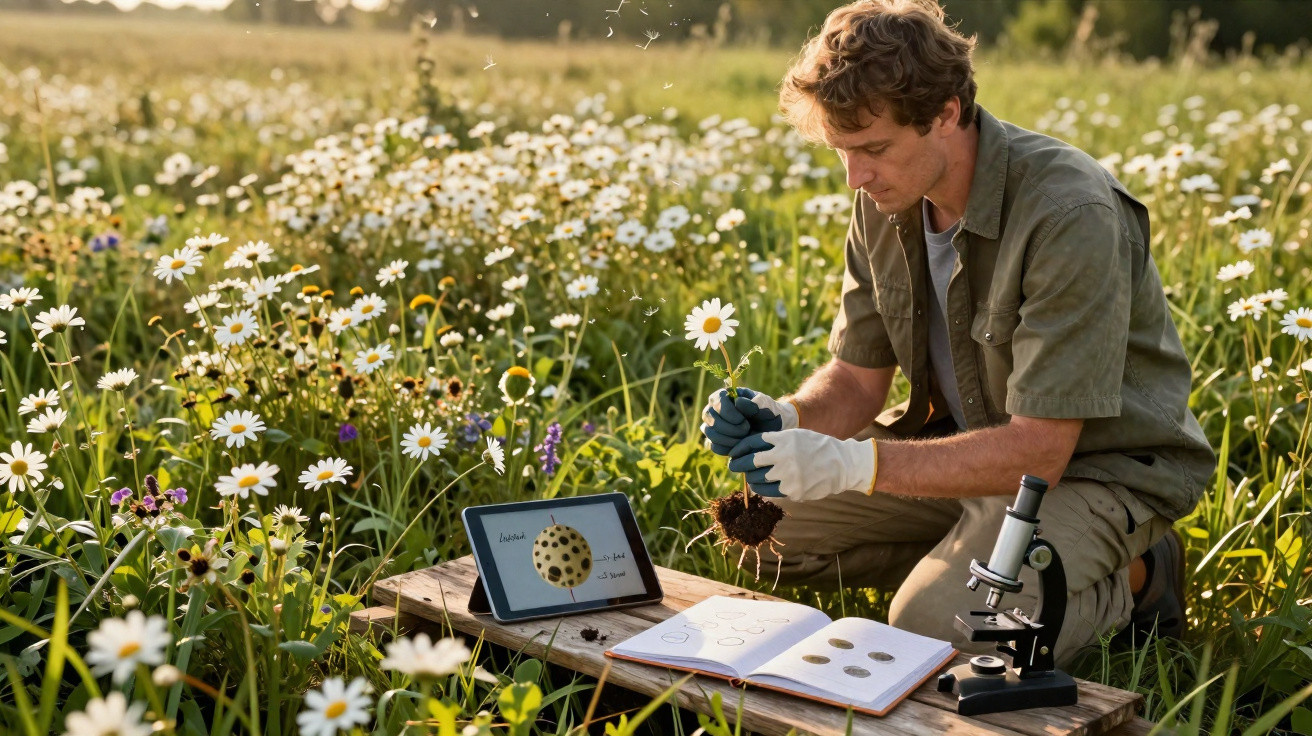
Fieldwork continued for an entire year. The researchers collected plants from untidy, disturbed locations, including roadsides and empty plots, throughout Karnataka and Tamil Nadu.
They cultivated seeds and cuttings from at least five plants of each species on campus.
Several native species were too difficult to raise in this way, so the team examined them in their natural habitats instead.
By the end of the study, the researchers had assessed around 900 plants.
What microscopy revealed
The crucial stage followed. Scientists compared flowers permitted to self-pollinate with flowers pollinated in the conventional manner, before assessing which resulting seeds were viable enough to germinate.
Fluorescent microscopy enabled an even closer examination.
Using this method, the team could determine whether a seed resulted from self-fertilisation or from apomixis, a form of seed production that occurs without fertilisation.
This difference is more significant than it may first appear. A seed formed without any pollen is a precise copy of its sole parent, enabling one plant to clone a population with almost no limit.
The researchers could then classify every species according to its reproductive strategy.
Every invasive plant reproduced alone
The result was striking. Each of the 11 invasive species was able to reproduce independently, without requiring another plant.
Most native species and the non-invasive introduced plants could not do so. They remained self-incompatible and still needed pollen from another individual to form seeds.
“Uniparental reproduction is a conceptually simple trait. It has been exciting to see such clear evidence of its advantage for invasive species,” said Professor van Nouhuys.
Two invasive plants altered their breeding strategy
Two species extended the finding further. Ageratum conyzoides and Bidens pilosa are among the most aggressive weeds in the entire group.
In their native Mexico, both species are mostly self-incompatible and depend on pollen from other plants. In India, where they are introduced species, they have moved towards reproducing entirely by themselves.
This comparison makes the evidence especially persuasive: the same species showed opposing reproductive habits on two continents, depending on whether they were in their native range or spreading elsewhere.
A change during invasion
This change particularly surprised the research team. It indicates that, as these plants expanded across India, individuals capable of self-fertilisation were the ones that succeeded.
“Before our experiments, the idea of reproductive strategies shifting during invasion seemed like a very far-fetched idea to me and I thought that previous evidences of such shifts were very rare occurrences,” said Narashiman.
“The results from our experiments and that of our collaborators absolutely baffled me.”
Improving predictions of invasive plants
The research also has a practical implication. Schemes assessing newly introduced plants for invasion risk commonly consider characteristics such as growth speed and climatic suitability.
The researchers argue that reproductive strategy should also appear on this list. Identifying whether a plant can reproduce alone may help authorities recognise the next major invader before it becomes established.
The issue is growing more pressing each year. Trade and travel continue to transport plants around the world, increasing the number of potential invasive species.
Invasive plants transform ecosystems
The consequences extend far beyond a single weed beside a road. Once an invasive species becomes established, plants already present in that environment usually begin to decline.
The effects then travel through the wider ecosystem. Insects that depended on those plants lose a food source, and birds higher up the food chain are affected in turn.
“Invasive species are called invasive for a reason,” said Professor van Nouhuys.
“They establish and then flourish in a new location. When this happens, existing species decline or disappear entirely, which changes the whole landscape.”
One seed landing beside a motorway, it seems, can mark the first step in a far broader transformation.














Comments
No comments yet. Be the first to comment!
Leave a Comment