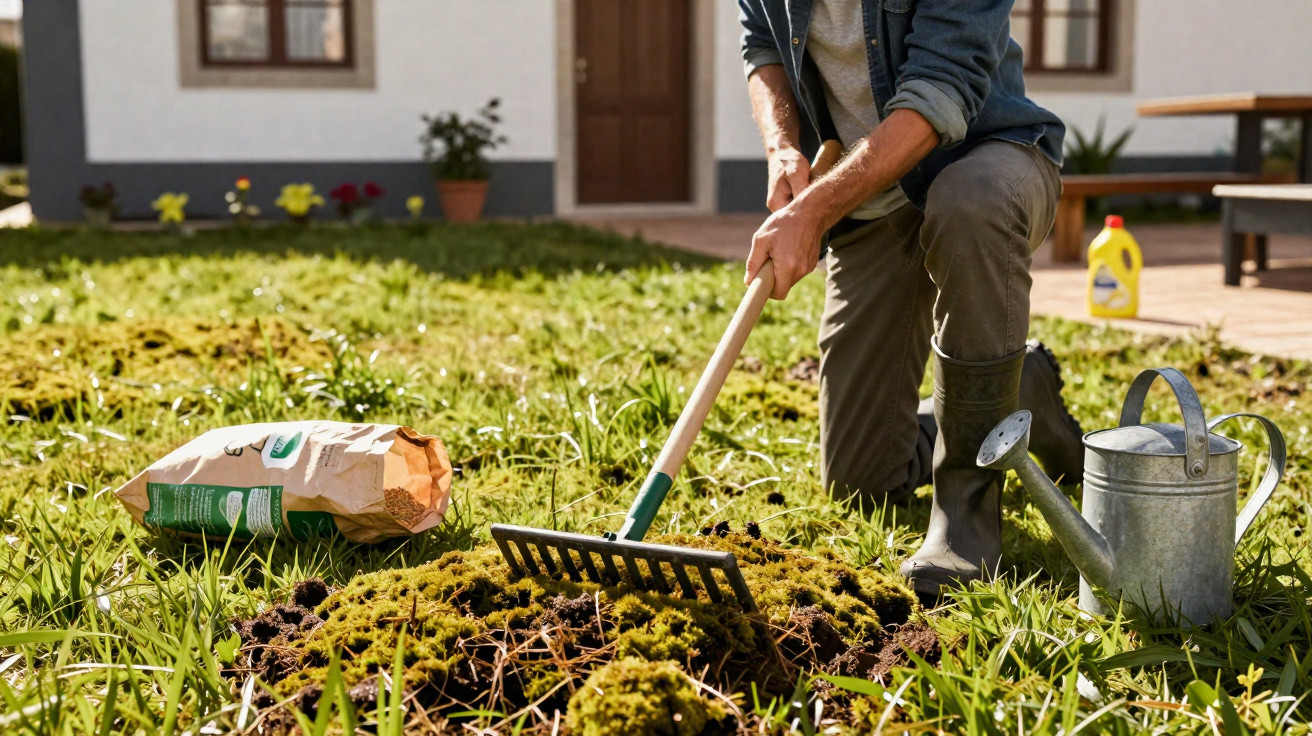
A lush green carpet known from autumn can suddenly give way to a patchy lawn covered in dark, soft cushions. Many amateur gardeners then turn to quick online tips – only to make the situation worse. One supposed “insider tip” in particular can cause considerable damage.
Why moss appears all over the lawn after winter
The scene is the same every year: as soon as the ground thaws, yellowish-green patches and dense cushions of moss emerge in the lawn. Areas beneath trees, beside hedges or in front of walls are especially affected, as they receive very little sunlight and moisture tends to build up there.
A lawn is put under pressure in several ways during winter. Cold temperatures slow its growth, prolonged wet conditions weaken the roots, and a lack of light deprives the grass blades of strength. Moss has an easy time in these weakened areas, growing wherever grass can barely compete.
Soil scientists and gardening experts also point to another issue: compacted, nutrient-poor soil. In places where children regularly play, cars are parked or large amounts of leaves are left lying around, the soil becomes compressed. Air reaches the roots less effectively, rainwater no longer drains properly and waterlogging develops. These are precisely the conditions moss prefers.
Moss rarely indicates only a “cosmetic problem” – it usually points to stressed, compacted or undernourished soil.
Anyone who gives their lawn very little care, mows infrequently and never scarifies it will therefore see the same pattern time and again: the grasses retreat while moss gradually takes control.
The biggest misconception: “saving” a lawn with washing-up liquid
For years, forums, videos and gardening groups have circulated an apparently brilliant solution: simply tackle moss with diluted washing-up liquid. Add a few squirts to watering water, spray the affected areas and the job is done – or so the advice goes. It sounds easy, cheap and clever. In reality, it is the opposite.
Washing-up liquid is designed to remove grease from plates and pans. These substances do not belong in soil. The surfactants it contains attack not only the cell structures of moss but also the delicate roots of grass. This weakens the lawn at exactly the point when it needs to regain strength after winter.
Landscape gardeners regularly report lawns that look patchy, thin and in some cases scorched after such experiments. At first glance, there may appear to be less moss, but the soil suffers out of sight. Micro-organisms, earthworms and other beneficial organisms that keep the soil loose and fertile are thrown out of balance.
There is an environmental concern, too: anything introduced into the ground can easily find its way into groundwater or nearby ditches. Washing-up liquid residues belong down the drain, not on the lawn.
Anyone who fights moss with washing-up liquid weakens their lawn in the long term – and unintentionally creates the perfect stage for the next carpet of moss.
The straightforward method professional gardeners really use
The good news is that a healthy lawn after winter does not require chemicals or risky kitchen experiments. Three traditional steps are usually enough, and they work reliably.
Step 1: Mow correctly
In early spring, once the ground is no longer muddy, it is time for the first cut. The lawn can be mown a little shorter than it would be in high summer. This allows more light to reach the turf, helps the area dry more quickly and removes some of moss’s advantage.
- Mow only when the soil is dry, otherwise further compaction can occur.
- Keep the mower blade sharp so that the grass blades are not frayed.
- Never remove more than one third of the grass blade length at once.
Step 2: Rake thoroughly or scarify
The first cut should be followed by the physically demanding but highly effective stage: combing through the lawn with a rake or scarifier. This removes loose moss, dead grass and thatch from the surface. Where moss is only a minor problem, a sturdy lawn rake is often sufficient.
If moss has already spread across large areas, using a scarifier is worthwhile, whether manual or powered. Its sharp blades score the soil surface by a few millimetres, pull out moss and thatch, and open up the top layer.
Immediately after scarifying, the lawn often looks worse than it did before – but a few weeks later the grass rewards the effort with noticeably denser growth.
These fine cuts enable air, water and nutrients to reach the roots more effectively again. The soil practically “breathes” a sigh of relief.
Step 3: Overseed and fill bare patches
Where moss has left large gaps, do not wait for something to grow back “on its own”. Special lawn overseeding mixtures will quickly fill bare areas. Lightly rake in the seed and, if needed, cover it with a thin layer of soil or lawn substrate so that it does not dry out or get picked off by birds.
During the following weeks, regular but gentle watering will help the young grass establish well. The denser the lawn becomes, the more difficult it is for moss to take hold.
When moss has already taken over
In some gardens, the green cushions become so dominant that mechanical measures alone are barely enough. Many people then use specialist moss treatments, often based on iron sulphate. This turns moss dark and causes it to die within a few days.
There is a drawback: applying the product too often or at too high a concentration damages the soil. The pH value can shift, while earthworms and soil life decline. The moss disappears in the short term, but the underlying issue – compacted, stressed soil – remains.
Home remedies such as wood ash or bicarbonate of soda are often presented as “natural” alternatives. However, their effects vary widely according to soil type. They often do almost nothing in calcareous soils, while their impact can be too strong in sensitive areas.
- Check the soil type and pH value before using any specialist treatment.
- Apply products only to targeted areas rather than across the lawn “just in case”.
- Always combine treatment with overseeding and soil improvement.
Preventing moss: lawn care that genuinely helps
To stop the same thing happening every spring, it is worth looking at the real causes. Treating a lawn as a living system means working against moss rather than against the soil itself.
| Problem | Cause | Sensible measure |
|---|---|---|
| Lots of moss in shaded areas | Too little light, constantly damp soil | Prune trees/hedges, use a shade-tolerant seed mixture |
| Moss on paths and in play areas | Compaction caused by foot traffic | Loosen the soil with a spade or aerating fork, work in sand |
| Moss despite regular mowing | Nutrient deficiency, depleted soil | Use suitable fertiliser in spring and autumn |
| Waterlogging after rain | Poor drainage, clay soil | Improve drainage, add sand and organic material |
Regular aeration – making small holes in the ground and filling them with sand – provides better ventilation over the long term. In heavily used gardens, it is worthwhile doing this at least once a year. Compost or organic fertiliser supplies nutrients without overloading the soil.
A more relaxed approach to moss
Not every patch of moss is a disaster. Conventional lawn grass generally struggles in very dark corners, beneath old fruit trees or in permanently damp, shady places. In such locations, it may be worth considering whether the moss can simply remain, or whether shade-loving ground-covering perennials, wood chips or a small natural area would be more suitable.
Knowing the causes makes for calmer decisions: lawn belongs where light, air and soil quality are right. Where those conditions are absent, suitable plants can often create a more attractive, lower-maintenance area than a lawn that is constantly struggling.
For the larger lawn area in the garden, however, the rule is clear: no washing-up liquid and no quick fixes. A clean cut, thorough scarifying, overseeding and a few measures to reduce soil compaction are usually enough to turn a tired winter lawn back into a robust green play area.
















Comments
No comments yet. Be the first to comment!
Leave a Comment