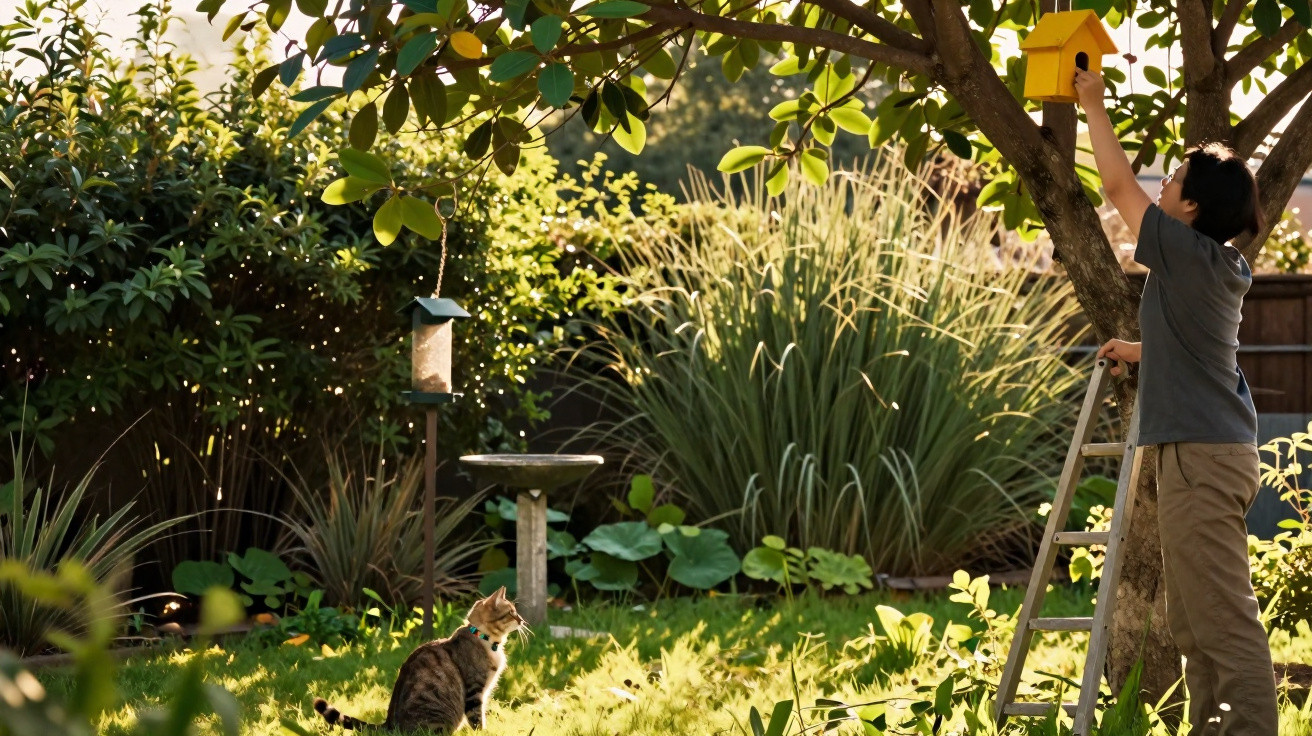
When fledglings are chirping in the shrubs and your own velvet-pawed cat prowls with its tail held high in search of prey, two passions collide. Many owners do not want to deny their cat outdoor access, yet they also do not want to witness a massacre among blackbirds, tits and robins. Thoughtful garden design can dramatically reduce a domestic cat’s hunting success without making the animal unhappy.
Why cats find their own garden so appealing
Domestic cats may seem relaxed, but their hunting instinct remains intact even when their food bowl is full. Some animals largely ignore birds, while others patrol their territory almost every day. The period from March to July is particularly sensitive, as many species nest on the ground or low down in hedges.
An overly tidy garden works in the cat’s favour. When leaves, long grass and dead wood are removed without exception, nesting materials, shelter and cover disappear. Nests are then more exposed, while young birds have neither hiding places nor escape routes – ideal circumstances for an accomplished hunter.
“The tidier the garden, the easier it is for the cat – and the harder it is for the birds.”
Anyone who cuts everything back rigorously at the start of the season and wants every corner to look ‘neat’ can quickly turn their plot into an open space where a four-legged hunter can stalk prey with very little resistance.
The ‘3-2-1 Refuge’: turning a prey zone into a safe haven
One effective approach is a tiered protected area, described here as the ‘3-2-1 Refuge’. The principle is to create garden zones with dense, multi-layered planting that interrupts the cat’s line of sight and gives birds genuine places to retreat.
How to create a safe refuge for songbirds
The structure acts like a small plant-built fortress:
- Level 1 – dense ground cover: hardy ground-cover plants such as sedges, cushion perennials or cranesbill create tangled undergrowth that is difficult to access.
- Level 2 – thorny shrubs: hedges of blackthorn, hawthorn, wild rose, barberry or hazel form an unpleasant obstacle for cats’ paws.
- Level 3 – small trees: compact trees or multi-stemmed woody plants break up the cat’s sightline while also providing safe perches for birds.
This refuge is especially effective when one part of the garden is left as undisturbed as possible from mid-March to the end of July. That means no pruning, no constant foot traffic and no major rearrangements.
“A protected strip in the garden can make the difference between a bird paradise and a hunting ground.”
Small changes that help birds straight away
Even manageable measures can significantly improve fledglings’ chances:
- leave at least one square metre of leaf litter beneath hedges and shrubs;
- retain a pile of branches and wood in one corner;
- before the first mow, leave a broad area of longer grass uncut;
- leave old, hollow perennial stems standing through the winter;
- cover beds with a thick layer of organic mulch.
These features shelter insects, worms and spiders, providing food for young birds. At the same time, they make it harder for a cat to launch fast, focused attacks.
The one garden idea that reconciles cats and birds
The central tactic repeatedly reported by cat owners is to ‘hide’ the most sensitive areas from their own pet rather than excluding it from the whole garden. This can be achieved through a combination of dense planting, intelligently positioned nest boxes and a kind of invisible boundary.
“The cat should be allowed to hunt in the garden – just not where fledglings are sitting.”
Those who deliberately turn a tree or hedge into a high-security zone for birds often find that noticeably fewer prey animals appear at the back door, even in the first year. Many owners begin with a single ‘key tree’, watch what happens and then expand the approach gradually.
Positioning nest boxes correctly
Nest boxes can be a game-changer – but only if they are genuinely out of a cat’s reach. A few basic rules apply:
- choose a height of around three metres;
- allow space from horizontal branches or projecting walls that a cat could jump from;
- face the entrance hole east or south-east to avoid intense midday sun and driving rain;
- avoid decorative perches, as these make access easier;
- leave around 15 to 20 centimetres between the entrance hole and the base of the box, so a paw cannot reach the young birds.
Many mistakes stem from good intentions: feeding stations or boxes are placed exactly where they look attractive – and where the cat can jump easily. A nest box on a low wall or in a low hedge is almost an invitation to a hunter.
“The worst solution: placing a feeding station or nest box at a height the cat can jump to.”
Gentle ways to curb keen hunting cats
Protecting birds does not require frightening your cat or keeping it indoors all the time. However, owners can reduce hunting success by limiting access at critical times and in sensitive places.
Times when cats are better kept indoors
Fledglings are particularly vulnerable during two periods: early morning and dusk. At these times, they are active and often still inexperienced, while cats are especially alert. Keeping your velvet-pawed companion indoors during these hours considerably reduces the risk of hunting.
A general guide for the breeding season from March to July:
| Time of day | Recommendation for outdoor access |
|---|---|
| Early morning | Keep indoors where possible |
| Midday / early afternoon | Relatively low risk; outdoor access is easier to justify |
| Evening dusk | Keep indoors where possible |
Tools that reduce hunting success
A number of small additional measures can help:
- a brightly coloured collar with a wide fabric ruff, which alerts birds to the cat’s presence;
- climbing deterrent guards on tree trunks, making them harder to climb;
- scents cats dislike, such as coffee grounds or citrus peel, in particularly sensitive areas;
- targeted planting with strongly scented species avoided by cats;
- neutering, which often reduces roaming and territorial urges.
It is important not to punish a cat if it does appear with prey. From its perspective, it is displaying normal behaviour; instead, it needs an environment that gives it fewer opportunities to succeed.
What else a bird-friendly garden provides
A garden that offers birds protection delivers several additional benefits. Denser vegetation and dead wood support more insects, including natural pest controllers. After one or two years, many amateur gardeners find that they need less spraying or hand-picking of pests.
There is another benefit too: children are more likely to become interested in nature when bird activity is easy to hear and see. Hanging nest boxes or creating a refuge together helps them learn about species, and later makes them view a cat’s hunting success more critically.
The matter can become legally relevant where very large numbers of cats are kept in a residential area and protected species are affected. Stricter management of outdoor access is particularly worthwhile in nature reserves and near valuable habitats. In these locations, owners can use large secure runs or ‘catios’ – enclosed outdoor spaces where a cat can be outside without hunting in the middle of a breeding area.
Owners who know their animals well can tailor the combination of measures accordingly. A slow, older cat may need only a few densely planted corners, whereas a young, fit hunter should be subject to greater limits. The more carefully owners observe where their cat walks and which routes it uses, the more precisely they can plan protected zones.















Comments
No comments yet. Be the first to comment!
Leave a Comment