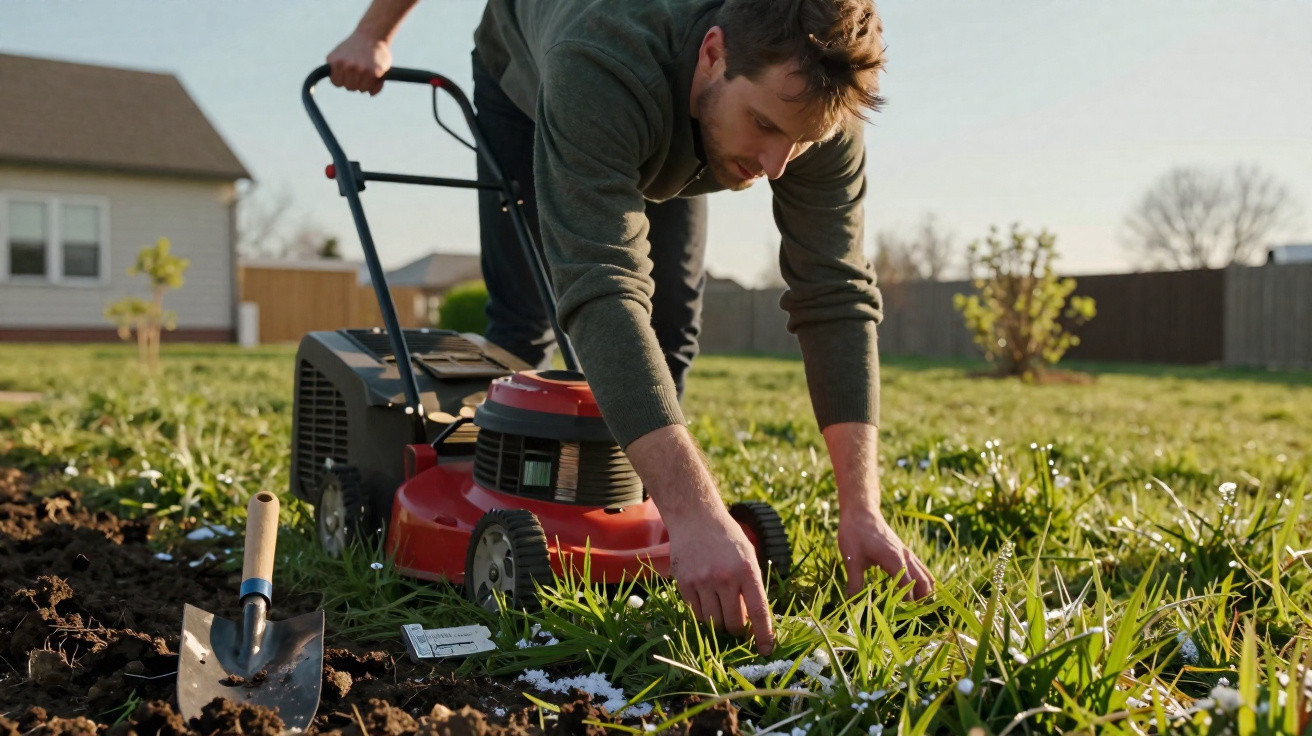
Looking out of the window: at last there is sunshine again, the lawn is sprouting and your hands are itching to head for the shed. But anyone who rushes outside now and cuts the grass as short as they would in high summer is making a common mistake. The consequences often emerge only weeks later: thin patches, moss and brown areas – despite wanting to get started “nice and early”.
Why the first lawn mow in spring matters so much
During winter, the lawn slows its growth considerably. Grass blades retain energy to protect the roots and the base of each plant. In spring, the grass urgently needs those reserves to restart growth, produce fresh shoots and develop a thick green cover.
As long as daytime temperatures rarely rise above 10°C and the soil remains cold or damp, this recovery process runs at reduced capacity. Mowing at this stage removes the leaf area the lawn needs to generate energy.
Cutting too early and too short deprives the lawn of the strength needed for a healthy start – and the weakening can still be noticeable in summer.
Rather than following a fixed date, assess both the weather and the condition of the lawn. Across central Europe, the growing season generally begins in March, although it may start later depending on the area. Key signs include:
- Daytime temperatures consistently above 10°C
- Soil that has thawed and is no longer constantly wet
- Grass that is deep green again and visibly growing
- Blades around 8 to 10 centimetres tall
Only when these signs coincide is it worth taking the mower out for its first pass.
The most common trap: mowing too early on wet or frozen ground
Many amateur gardeners intervene as soon as the lawn appears “untidy”. Once the blades become slightly taller, they start the mower regardless of how the ground feels. That is exactly where the trouble begins.
If the soil is still frozen or waterlogged, a mower has the effect of a roller. Its weight compacts the soil pores, forcing air and water from the small spaces within it. Roots receive less oxygen, while young shoots can be flattened or torn away.
The result is often a familiar sight: yellowish patches, wheel marks and sometimes even bare spots. Moss and weeds can then spread easily there, because the lawn is too weak to fill the gaps itself.
How to check whether the soil is ready
A quick foot test is a useful everyday method: if the lawn gives way heavily underfoot and feels like a wet sponge, it is still too soon. When the surface is firm enough to support you without becoming slippery or sinking, the right time is getting closer.
A spade gives an even more precise answer: lift out a small section, inspect it and put it back. If the soil block breaks apart and is fairly dry and crumbly, conditions are suitable. If everything sticks together in a slimy mass, patience is the better option.
The second mistake: cutting far too short in spring
A classic “golf-course look” in March or April may be tempting, but it quickly backfires. Although short blades look neat, they remove a large amount of the grass’s leaf area. Less leaf surface means less photosynthesis and therefore less energy.
For the first cut, remove no more than one third of the blade height – taking more noticeably harms the lawn after winter.
For example, if the lawn is 9 centimetres high, do not scalp it down to 3 centimetres. A cutting height of roughly 6 centimetres is preferable. In general, the first cuts of the year should leave the grass between 5 and 7 centimetres high.
This height offers several benefits:
- The soil receives more shade and does not dry out as quickly.
- Roots grow deeper because they are not repeatedly cut “back to zero”.
- Weed seeds struggle more to find light and space.
- The lawn looks thicker and more vigorous.
The correct lawn mower setting
For the first lawn mow in spring, set the mower to its highest setting, or at least one of its upper settings. Many people set it much too low because they are used to a very short cut in high summer.
If you are unsure, follow this straightforward sequence:
- Make the first cut on a very high setting.
- For the second or third mow, lower the setting gradually by one notch if desired.
- Always ensure that no more than one third of each blade is removed.
Sharp blades are just as important as the cutting height. Blunt blades tend to tear grass rather than cut it cleanly. The blade tips become ragged, turn brown and provide entry points for fungi and disease.
Giving the mower a spring service – sharpening the blades and cleaning the machine – pays off throughout the whole summer.
These signs show that you can mow now
Before starting the engine, one final check is worthwhile. Conditions are good for a first mow when:
- the forecast shows no overnight frost in the coming days,
- you can walk on the ground without leaving deep footprints,
- the blades are visibly putting on new growth rather than merely “standing” there,
- the grass has returned to a strong green colour.
When these points apply, there is no reason not to make the first careful cut on a high setting.
What helps the lawn after the first cut
Anyone wanting to strengthen their lawn over the long term should use spring for more than just mowing. Gentle scarifying or aerating on firm ground helps remove thatch and allows more oxygen to reach the roots. Bare patches can be filled with overseeding.
Fertilising also has a part to play at this point. A mild lawn fertiliser with a higher nitrogen content supports new growth and encourages density. The soil should be slightly moist, and rain over the next few days is ideal for helping the nutrients soak in.
Common questions from amateur gardeners
Many people wonder how to tell whether their lawn is genuinely “weakened”. Typical indicators are:
- yellow or brown tips appearing repeatedly after mowing,
- increasing moss in partially shaded areas,
- very uneven growth heights that hardly level out,
- thin patches that do not fill in by themselves.
In these cases, it is worth keeping the cutting height slightly higher permanently and mowing less often, but at the right time. In many gardens, a dense lawn left a little longer is far more resilient than a closely shorn surface.
Why patience in spring achieves more than perfection
The urge to make the garden look “tidy” is understandable. However, lawns react sensitively to this. Waiting one or two extra weeks until the soil and temperatures are genuinely suitable rewards you with less maintenance and fewer frustrations over brown patches for almost the entire season.
There is another consideration: longer grass blades also provide small creatures and insects with more places to shelter during the transitional period. By not turning the first mow into a drastic cut, you also protect the microfauna in your own garden.
Ultimately, one simple rule produces a much healthier lawn: never too early, never too short. Avoiding this single mistake lays the foundation for a resilient, deep-green lawn from spring through to autumn.

















Comments
No comments yet. Be the first to comment!
Leave a Comment