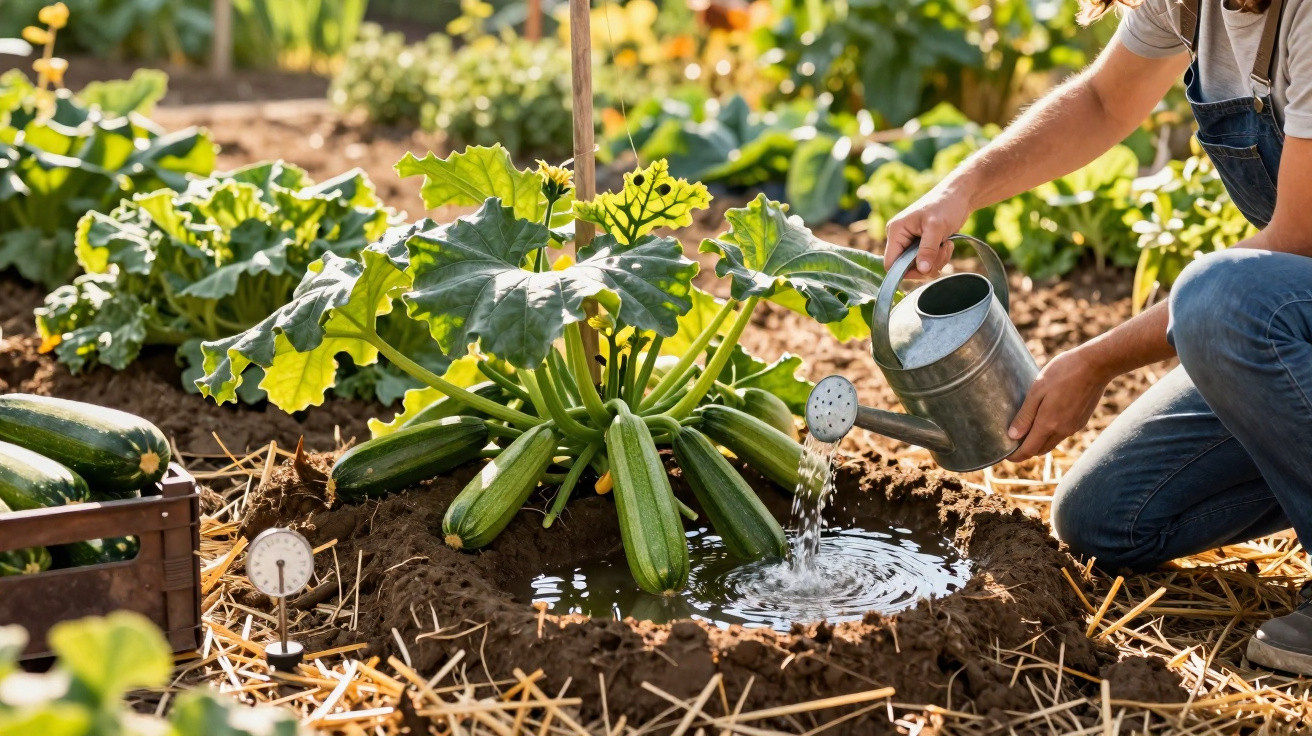
Many keen gardeners grow courgettes every year, only to be disappointed when just a few meagre fruits are left on the plant at the end of the season. A professional gardener now shares a straightforward watering technique that can help a single plant produce between three and five kilos of courgettes - without high-tech equipment or costly products.
Why courgettes need so much water - and where things often go wrong
Originally from warm regions, courgettes grow exceptionally quickly. That rapid growth comes at a cost: their large leaves lose a great deal of water through evaporation. Skimping on water, or watering incorrectly, can result in undersized fruit, disease or even the entire plant dying.
Two common mistakes are particularly widespread:
- Watering too infrequently, but using enormous volumes of water each time.
- Watering from above onto the leaves rather than reaching the root zone.
“What matters is not the amount of water given at one time, but how consistently and how close to the roots the plant receives it.”
Courgettes cope well with two to three watering sessions per week, provided that roughly one 5-litre watering-canful per plant actually reaches the soil each time. The key is to allow the ground to absorb the water instead of letting it simply run off.
The “basin method”: a small hollow with a big effect
Pierre, a gardening professional known from French television, describes a technique that sounds simple but can have a considerable effect on the harvest. Around each courgette plant, create a small watering basin - essentially a miniature crater in the soil.
How to make the ideal watering basin
This approach works in both open beds and raised beds. No specialist equipment is required; a hand hoe or even your hands will do:
- Loosen the soil around the plant to a radius of around 20–30 centimetres.
- Gently pull soil upwards from the outer area to form a small raised rim.
- Leave a depression in the centre, directly around the stem: this is the watering basin.
- Take care not to dig too deeply and damage the roots.
When watering, the water remains within this hollow instead of flowing away in every direction. The soil can take up the moisture gradually, while the roots receive an even supply.
“The watering basin acts like a small water reservoir: water drains away slowly and reaches the deeper roots instead of compacting the surface.”
Why “progressive watering” works so well
The real skill is not simply pouring a large rush of water into the basin. A gradual method is more effective:
- Add an initial small amount of water and wait briefly.
- Once the water has almost drained in, add more.
- Continue in this way until the plant has received around five litres.
This slow approach prevents a hard crust from developing on the surface, something that often happens when a large amount of water hits dry soil. It is a particularly common issue in uncovered soil exposed to sunshine.
Mulch, temperature and timing: getting the most from the courgette method
Watering technique alone is not the only factor when aiming for the 5-kilo mark per plant. Soil temperature, mulching and planting at the right time also make a difference.
Warmth is essential: do not plant until the soil is ready
Courgettes are vulnerable to frost. Planting them too early can lead to frost damage or plants that languish for months in cold ground. The basic rule is:
- Start them in pots indoors or in a greenhouse.
- Plant them outside only when there is no longer any risk of overnight frost.
- The soil should be consistently at least 12 to 15 degrees warm.
If a courgette is planted in soil that is too cold from the outset, its roots develop only slowly. Even perfect watering later on can barely make up for this poor start.
Mulch prevents drying out and surface compaction
Another way to improve a courgette harvest lies directly on the soil: mulching. A thin layer of organic material around the plant offers several benefits at once:
- The soil loses moisture more slowly.
- Rain and watering do not compact the surface as severely.
- Soil life remains more active, creating better conditions for the roots.
Suitable materials include dried-off grass clippings, shredded leaves, straw or seed-free plant debris. Combined with a watering basin, this creates a kind of “water-management system” that supports courgettes particularly well.
How often you should actually water
How often you need to use the watering can depends heavily on the weather, soil type and mulch layer. The following is a broad summer guide:
| Soil type | Weather conditions | Watering frequency |
|---|---|---|
| Sandy soil | Hot, dry | 3 times per week |
| Loamy soil | Warm, changeable | 2 times per week |
| Good garden soil with mulch | Normal summer rainfall | 1–2 times per week (depending on rain) |
Here is a practical test: push a finger around five centimetres into the soil inside the watering basin. If the soil feels dry at that depth, it is time for the next watering can.
Harvest time: encouraging new courgette fruits
Courgettes are genuine production machines - if you let them be. The professional gardener puts it simply: harvesting regularly encourages the plant to make new flowers and fruits. Repeatedly waiting “too long” slows it down.
“Every courgette you harvest sends the plant a message: ‘Keep going, produce new fruits!’”
The ideal time to harvest
Key signs that a courgette is ready to pick include:
- It is usually between 15 and 25 centimetres long, depending on the variety.
- The fruit feels firm, but not hard like wood.
- It can be cut easily from the stem with a sharp knife or scissors.
Harvesting too early produces particularly tender fruit, but it stores poorly and shrivels quickly. Courgettes left too long, on the other hand, become watery and oversized, taking a great deal of energy from the plant that could have gone into several smaller fruits.
Common problems and how the watering method helps
Even with good care, courgette plants can sometimes cause concern. Several classic problems can be reduced or avoided through this method of watering:
- Yellow leaves: These can indicate a nutrient deficiency or waterlogging. A watering basin combined with progressive watering significantly reduces waterlogging.
- Rotting fruits: This is often caused by fruits resting on permanently damp soil. A good mulch layer helps because it dries more quickly and provides a softer surface for the fruits.
- Fungal leaf diseases: Wet foliage after evening watering encourages fungal problems. It is better to water directly at soil level in the morning or early evening, rather than watering over the leaves.
Delivering water directly into the basin keeps the foliage comparatively dry, which makes an important contribution to plant health.
Useful additions: fertiliser, companion plants and variety choice
Anyone looking to make the most of their crop can add further measures to the watering strategy. Nutrients, companion planting and variety selection are three particularly important considerations.
Gentle feeding rather than a turbo shock
Courgettes respond well to a steady supply of nutrients. Good options include:
- Compost worked into the soil when planting.
- A mild organic liquid fertiliser in the watering water every two to three weeks.
- Well-rotted manure or plant liquid feed in low doses.
The watering basin is ideal for delivering liquid fertiliser directly to the roots without flooding the whole bed. The plant absorbs nutrients where it needs them most.
Good neighbours and smart combinations
Courgettes like to spread out, but they do not suit every planting scheme. Suitable plants nearby include:
- Beans, which fix nitrogen and improve the soil over the longer term.
- Marigolds and nasturtiums, which attract insects and divert aphids.
- Onions or garlic, which may help keep pests away from the root area.
Close planting alongside other hungry crops such as pumpkins or melons is less suitable, as they compete strongly for water and nutrients in a confined space.
Why the effort is worthwhile
Anyone who creates a watering basin, waters progressively and pays attention to soil temperature, mulch and harvest timing will often notice a difference after only a few weeks: stronger plants, more flowers and regular fruit formation.
Perhaps the greatest advantage is that two or three well-maintained courgette plants can easily supply an entire family - including neighbours pleased to receive the occasional basket of fresh courgettes. You will also know exactly how those quantities were achieved: through a simple, well-considered watering technique applied directly at the roots.












Comments
No comments yet. Be the first to comment!
Leave a Comment