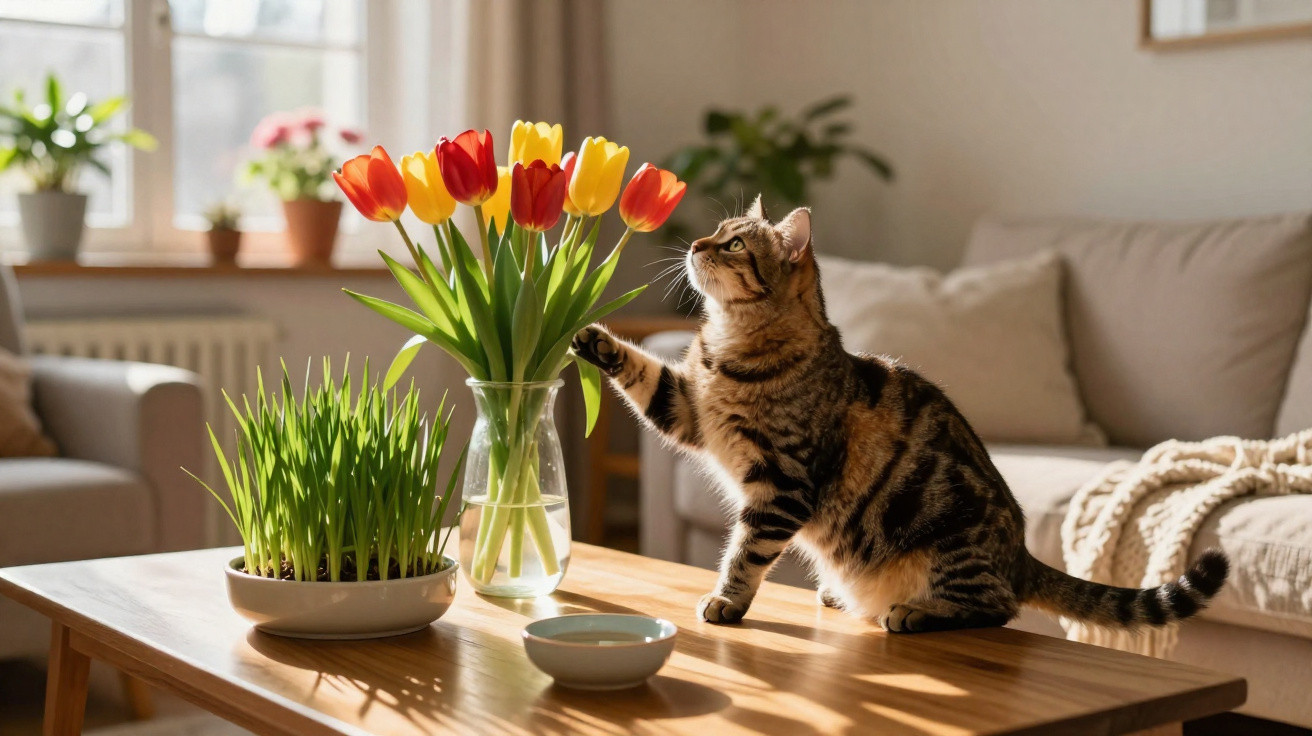
Many cat owners immediately think of poinsettias or lilies when poisonous plants are mentioned. Tulips, by contrast, seem innocent, colourful and cheerful. That is precisely why they appear in large numbers in homes and gardens – often without anyone considering the inquisitive cat that chews and licks everything. Anyone wanting to make their home safe for cats should understand what tulips can do inside a cat’s body and how problems can be prevented reliably.
Tulips at a glance: attractive to people, risky for cats
Tulips belong to the Tulipa genus and are sold in countless colours and shapes. We see them mainly in spring, whether in parks, front gardens or living rooms. For cats, the danger lies not in their appearance but in particular compounds they contain.
Tulips contain substances known as tulipalins, chemical compounds that protect the plant from fungi and germs. They may irritate or poison cats, with the bulbs containing particularly high concentrations.
Tulips are considered moderately toxic to cats – and the bulbs in particular pose a risk.
Commonly found species include:
- Tulipa gesneriana – the classic garden tulip and the most widespread variety
- Tulipa clusiana – a delicate species popular in warmer parts of Europe
- Tulipa agenensis – more commonly found growing wild in parts of Europe and the Middle East
In day-to-day terms, it makes little difference to a cat which species is in the flowerbed or vase: all contain tulipalins and can therefore cause problems.
How toxic are tulips to cats?
Tulips are not at the very top of the list of the most dangerous poisonous plants, but nor are they a harmless decoration. Experts generally classify their toxicity to cats as moderate.
In practice, this means that eating a small amount of leaf or flower will usually cause “only” gastrointestinal upset. The risk increases if a cat eats parts of the bulb or keeps nibbling at the plant. Although many cats will not do this voluntarily, curious young cats or bored indoor cats often experiment more than we would like.
The highest concentration of toxic substances is found in:
- the bulb (underground or in the potting compost)
- stems and leaves
- flowers (at a lower concentration, but still not harmless)
Typical symptoms of tulip poisoning in cats
If a cat has chewed tulips or swallowed parts of the plant, signs generally develop quite quickly – often within a few hours. Common symptoms include:
- Gastrointestinal problems: nausea, vomiting and sometimes diarrhoea
- heavy drooling: irritation to the lining of the mouth can cause strings or drops of saliva around the mouth
- restlessness or withdrawal: some cats seem lethargic, while others pace around nervously
- changed eating behaviour: refusing food or licking only liquids
Anyone who sees their cat nibbling tulips, or finds that the plant has suddenly been chewed, should monitor their pet closely rather than waiting to see whether “it will just go away”.
Severe poisoning involving circulatory problems is uncommon with tulips, but cannot be ruled out, especially if bulbs have been eaten or the cat is very young, old or has an existing illness.
What to do if your cat has eaten tulips
In an emergency, every minute matters – not because there is a need to panic, but because contacting a professional early can prevent many complications.
First steps for cat owners
- Stay calm and do not pressure the cat.
- Remove plant material if it is still visible in the mouth.
- Keep any remaining parts of the plant or take a photograph so the vet can identify it.
- Call your veterinary practice or an emergency vet straight away and explain what has happened.
Never try to make your cat vomit yourself, give salty home remedies or administer “any” medication. All of these actions can make matters worse.
How a vet may treat tulip poisoning
Depending on the amount eaten and the symptoms, several measures may be considered:
- Antiemetics – medicines that reduce vomiting
- Antidiarrhoeals – treatments for diarrhoea
- Fluids by drip – to stabilise circulation and replace lost fluids
- Monitoring – in severe cases, the cat may remain at the practice for several hours or overnight
With appropriate treatment, symptoms return to normal within one to two days in many cases. Acting quickly helps protect your cat from prolonged discomfort and lasting effects.
Enjoying tulips safely: practical protection for cat households
The good news is that nobody needs to pull every tulip out of the garden immediately. A few simple precautions can substantially reduce the risks.
Tips for gardens and balconies
- Plant bulbs out of reach: rather than using easily accessible planters, plant tulips in deeper beds or securely protected containers.
- Cover the soil: protect the soil around plants with wire mesh, stones or bark mulch to stop cats digging.
- Provide alternative areas: a dedicated “cat area” with safe plants can divert attention away from tulips.
Tulips indoors – is it possible at all?
Those who do not want to give up a spring bouquet should keep the following in mind:
- Put the vase somewhere the cat genuinely cannot reach, rather than directly on a windowsill or low table.
- Watch whether your cat takes an interest in the flowers. Some cats ignore them completely, while others are fascinated.
- Dispose of wilted leaves and flowers promptly, so that nothing drops onto the floor.
A bouquet of tulips in a home with a very curious indoor cat always carries a residual risk – anyone wanting to be completely safe should choose non-toxic alternatives.
Why cats nibble plants at all
Many cat owners wonder why their otherwise fussy pet suddenly attacks greenery with enthusiasm. The reasons can vary greatly:
- curiosity, particularly in young cats
- boredom in cats kept exclusively indoors
- an attempt to get rid of hair from the stomach
- simply enjoying the taste or texture
Providing your cat with a safe alternative lowers the chance that it will chew dangerous plants.
Safe alternatives: what cats can eat instead of tulips
Rather than constantly saying “No!”, it often works better to offer a clear “Yes, you may have this.” Suitable options include:
- cat grass – usually grown from oats, barley or wheat, and encourages the regurgitation of hairballs
- non-toxic houseplants such as certain palm species, including the areca palm, spider plants or Golliwoog
- fresh herbs such as catnip or valerian (in moderation)
A pot of fresh cat grass that is always available reliably distracts many indoor cats from cut flowers and poisonous plants.
Further risks associated with tulips and other ornamental plants
The plant itself is not the only hazard; fertilisers and pesticides are another frequently overlooked risk. Flower bulbs may be pre-treated, while cut flowers can be treated with nutrient solutions or sprays. These substances may cause further irritation or be toxic if a cat licks a stem or drinks the water from the vase.
| Hazard | Where it is found | Risk to cats |
|---|---|---|
| Tulipalins | Tulip bulb, leaves, flowers | Gastrointestinal irritation, drooling |
| Fertiliser residues | Potting compost, bulb surface | Additional chemical exposure |
| Vase additives | Water in the flower vase | Diarrhoea and vomiting after drinking |
Choosing organic compost, using few chemicals and providing fresh water avoids some of these dangers from the outset.
How to make your home safe from harmful plants
Focusing on tulips alone is not enough, as many popular indoor and garden plants can harm cats. A quick plant check is worthwhile:
- Make a list of the plants you already have.
- Look up every species in a reputable poisonous-plant database for animals.
- Remove highly toxic species, such as true lilies, dumb cane and oleander, or make them inaccessible.
- From now on, buy only new plants considered safe for pets.
This gradually creates a home where cats and plants can live together peacefully – and where a spring bouquet does not become a danger.













Comments
No comments yet. Be the first to comment!
Leave a Comment