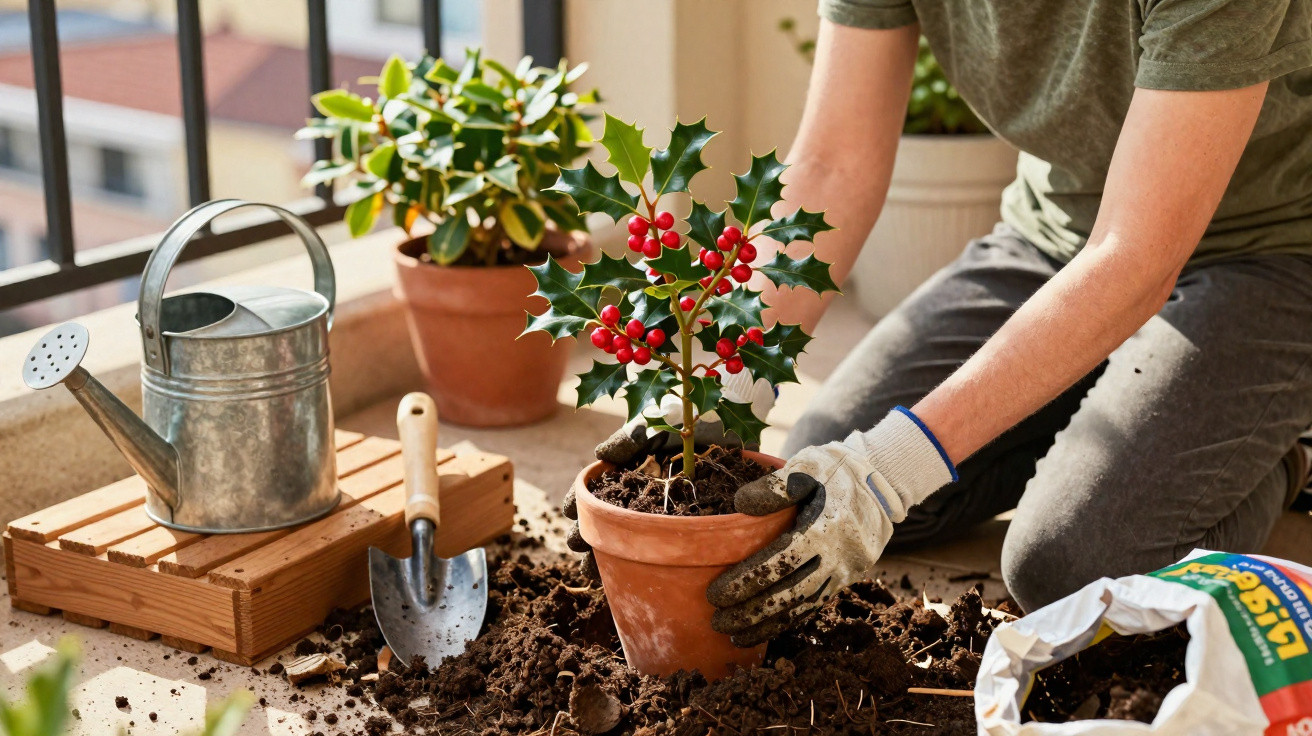
While most beds are still bare, experienced gardeners turn to an evergreen classic with red berries, believed to bring vigour, colour and, symbolically, protection. Planting by early March gives the whole garden a head start – whether it is grown in a border or a large container on the balcony.
A shrub with a reputation as a good-luck charm
This is the European holly shrub, known to many simply as holly or the Christmas shrub. Its foliage remains green throughout the year, while vivid red berries appear in autumn and winter. People have been captivated by this striking colour contrast for centuries.
Evergreen foliage and bright-red berries have made holly a symbol of protection, resilience and new beginnings.
Across many parts of Europe, this shrub was traditionally planted beside homes to ward off misfortune and “guard” the household. Its prickly leaves were viewed as a natural shield, while its red fruits represented life force in the depths of winter.
Beyond this symbolism, the plant offers several thoroughly practical benefits:
- Hardy: tolerates frost without difficulty
- Shade-tolerant: grows well in partial shade
- Versatile: suitable as a dwarf shrub in a container or a tall specimen tree
- Year-round decoration: evergreen rather than merely a “Christmas gimmick”
Gardeners also value holly because there are more than 400 varieties, ranging from exceptionally compact ornamental forms for city balconies to imposing shrubs that make a real feature in front gardens.
Why planting before early March matters so much
Anyone hoping to plant this good-luck shrub should make purposeful use of the period up to early March. Planting at this time offers several advantages.
Roots establish before the heat arrives
By late winter, the soil is generally well supplied with moisture. That is precisely what the shrub needs to root in quickly. Before the proper warmth of spring begins, it can develop fine roots that will later provide a dependable water supply during summer.
Planting before early March means that holly can establish itself undisturbed before dry spells and hot weather arrive.
The benefits become clear later on. Plants that have settled in well are more likely to produce abundant berries, grow more densely and cope better with brief periods of drought.
A visible ritual for a fresh start
Many people deliberately use late winter to mark the beginning of a new chapter, whether at home, at work or in their personal lives. A newly planted shrub can quickly become a kind of symbol:
- A fresh start for the garden
- A permanent feature on the balcony that remains as other plants change
- A visible sign: “Things are moving forward from now on”
This combination of practical strengths and symbolic appeal explains why the shrub is currently in such demand.
How to plant holly successfully: step by step
The good-luck shrub needs little to make a strong start, but several details do matter. Following the guidance below helps prevent common mistakes.
Position, spacing and number of plants
One plant alone will usually not be enough for a generous berry crop, as many varieties have separate male and female plants. This is less complicated than it sounds.
- Number: One male shrub is sufficient as a pollinator for three to five female plants.
- Garden spacing: Leave 1.5 to 2 metres between plants, or 1 to 1.2 metres for dwarf varieties.
- Balcony container: Use a well-drained pot measuring 30–40 cm in diameter and depth.
A partially shaded position is perfectly suitable. Direct midday sun is also possible provided the soil does not dry out completely. Exposed, windy spots are less suitable, particularly for young container-grown plants.
The correct planting hole and soil
A properly prepared planting hole makes all the difference, especially where the soil is heavy.
| Task | Recommendation |
|---|---|
| Size of planting hole | approximately 40 cm wide and 40 cm deep per plant |
| Soil improvement | mix in around 5 litres of mature compost and 2 litres of coarse sand or fine gravel |
| Watering immediately after planting | 5–10 litres of water per shrub |
| Mulch layer | around 5 cm of organic mulch around the plant |
Plant it as follows:
- Dig the hole and loosen the soil at its base.
- Combine the excavated soil with compost and sand or gravel.
- Position the shrub so that the top of its root ball sits level with the surrounding soil.
- Refill with the prepared soil and firm it only lightly.
- Water thoroughly, then apply a layer of mulch.
Care: little effort, strong results
Once established, the shrub is fairly undemanding. Most care is needed during its first year.
Watering and feeding
During the first month after planting, it is worth checking it weekly:
- In dry conditions, give around 5 litres of water once a week.
- Avoid waterlogging at all costs, particularly in pots.
From its second year onwards, a shrub planted in the ground only needs watering during prolonged dry periods. Compost in containers dries more rapidly, so it should be checked regularly. A moderate, balanced fertiliser in spring is usually enough if the plant is growing weakly.
Pruning and shape
Pruning shears or a saw are needed once a year, towards the end of winter. A light trim for shape and maintenance is all that is required:
- remove dead shoots or those growing inwards
- thin the centre of the crown slightly so that air and light can reach it
- selectively shorten awkward branches that protrude too far
Those who prefer a more natural, slightly wild appearance can prune less often. The shrub tolerates both approaches: a formal shape or looser growth.
Wildlife-friendly, but not without risk: what households should consider
The red berries are highly attractive to birds. Blackbirds and other species use them as a winter food source. The shrub therefore supports biodiversity, which is a significant advantage in built-up areas.
The berries feed birds, but they can pose a danger to small children and pets.
For people and many pets, consuming larger quantities of the fruit is poisonous. Stomach pain, nausea and more serious effects in severe cases may follow. Parents of young children should avoid planting the shrub directly beside a sandpit or in usual play areas. Fallen berries are easy to collect when they land on paved surfaces.
Choosing native species is also sensible. Regional wild forms fit more naturally into their surroundings and often provide greater benefits for insects and birds than exotic varieties.
Holly varieties suited to balconies and gardens
Selecting the right variety determines whether the shrub becomes a prickly giant or an easy-care container plant. Nurseries commonly offer, among others:
- Compact dwarf forms – ideal for pots and small terraces
- Medium-sized hedging forms – for structured front gardens or screening
- Berry-rich female varieties – for anyone wanting vivid winter decoration
Anyone wanting plenty of berries should specifically ask for female varieties when buying and take home a suitable male pollinator at the same time. Many specialist nurseries already state this on the plant label.
Local tree nurseries and garden centres generally begin selling them from February. They can advise on the right variety for local climate, soil and position – a conversation that can save beginners a great deal of frustration.
More than decoration: ways to use the good-luck shrub
In addition to its role as a good-luck symbol and bird magnet, the shrub has a place in everyday styling. Its branches can be made into winter wreaths or table arrangements, which last considerably longer than many other cut plants. However, anyone cutting branches should always leave some berry-bearing stems for the birds.
It is particularly effective combined with other tough plants, such as box alternatives, grasses or early-flowering bulbs. This creates a lively display in a front garden or on a balcony as early as February and March, breaking up the typical winter gloom in the border.
Planting the shrub before March combines practical gardening knowledge with a small ritual of greater confidence. This is exactly what makes it so sought-after at this time of year – and why many gardeners secure their good-luck charm early.












Comments
No comments yet. Be the first to comment!
Leave a Comment