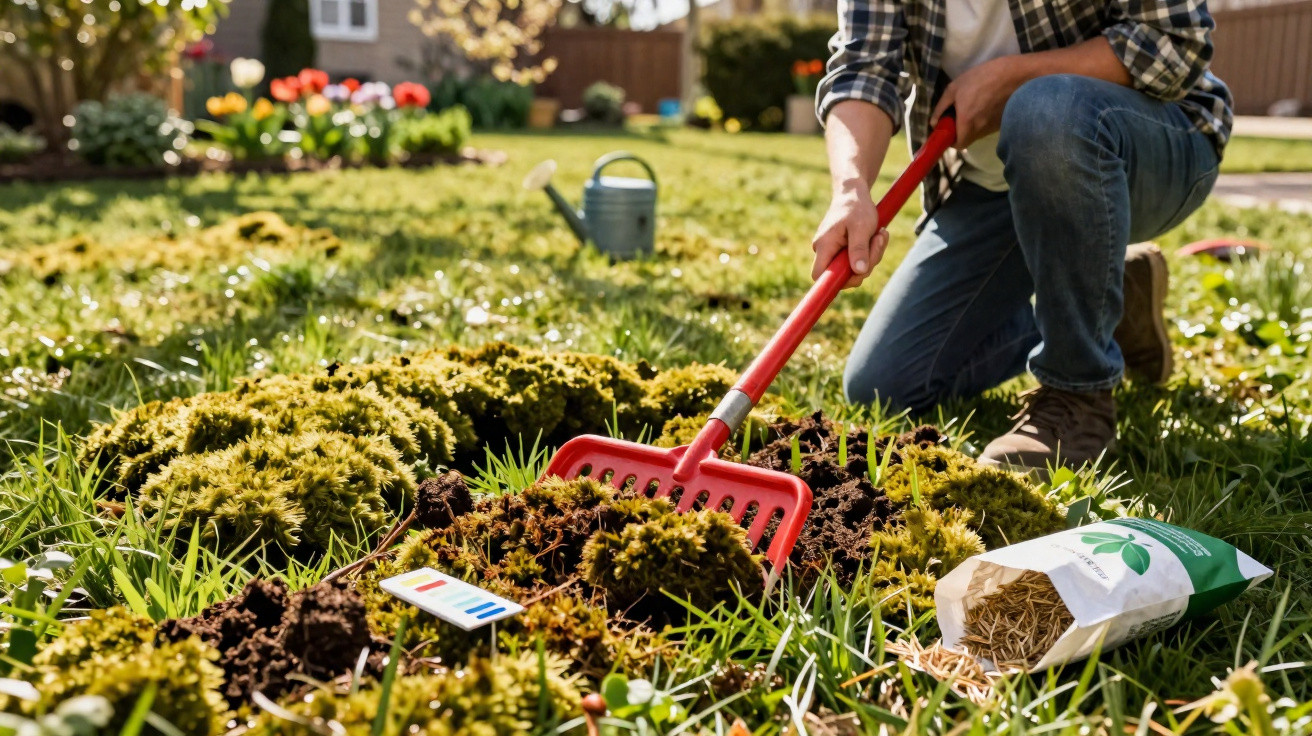
After a long, wet winter, a garden can seem as though it has abruptly woken from hibernation. Areas that held thick grass in autumn are now covered with soft cushions of moss. Many people then turn to dubious online tips – and end up doing more harm to their soil than good. Choosing the wrong method in spring can leave you battling a patchy, unhealthy lawn all summer.
Why moss suddenly spreads everywhere in spring
The same pattern plays out in many gardens every year: as soon as the ground has thawed, large patches of moss appear across the lawn. Shaded, damp spots are particularly vulnerable – beneath trees, beside dense hedges or in places that receive only a few hours of sunlight.
The explanation is straightforward: lawns suffer over winter. Cold weather, waterlogging and limited light weaken the grass. Growth is minimal and the roots barely function. Moss takes advantage of precisely this gap. It needs far fewer nutrients, copes with low light and thrives in damp, compacted soil.
Soil scientists and gardening specialists repeatedly point to the same causes:
- Compacted ground – caused, for example, by frequent foot traffic, children playing, garden furniture or cars at the edge of a drive.
- Nutrient deficiency – the lawn is underfed, while moss copes better with these conditions.
- Too much shade – dense foliage, tall hedges or walls blocking the sun.
- Persistent dampness – water that drains poorly or heavy clay soil.
Where several of these factors occur together, grass gradually loses its vigour. The result is that the moss patches grow larger each year while the lawn becomes increasingly sparse – unless action is taken.
Moss is not an “enemy”; it is a symptom that shows the conditions are poor for grass.
The risky online tip: “magically” removing moss with washing-up liquid
Countless home remedies for moss circulate online. One especially popular suggestion is diluted washing-up liquid, spread over the lawn with a watering can. It may sound like an easy, inexpensive fix, but it is a classic springtime mistake.
Washing-up liquid is designed for greasy dishes, not living soil. Its surfactants break down fats, alter surface tension and attack biological structures. In a garden, this affects not only moss but also sensitive grass roots and the tiny organisms living in the soil.
What washing-up liquid really does to soil
Experts in soil biology and landscaping have warned against these “tricks” for years. Possible consequences include:
- weakened grass roots
- dying soil life, including earthworms and micro-organisms
- disrupted soil structure, leaving the ground claggy or waterlogged
- nutrients being washed into deeper layers and into groundwater
Anyone who applies washing-up liquid liberally may notice a short-term change on the surface of the moss. Over time, however, the soil becomes poorer and the grass cover thinner – precisely the conditions moss loves. Rather than solving the problem, this makes it worse.
Quick chemical tricks may save time at the weekend, but in the long run they cost the lawn its health.
A better approach to moss in the lawn: mechanical methods instead of “miracle” products
The good news is that moss in a lawn can be tackled with simple measures. There is no need for specialist chemicals, expensive miracle treatments or risks to soil and groundwater.
Step 1: Mow correctly and rake thoroughly
The best time to begin is early spring, once the soil has dried out and temperatures remain consistently above 5°C. The following order works well:
- Mow short – cut the lawn slightly lower than usual once, but not down to bare earth.
- Rake firmly with a leaf rake or scarifying rake – this loosens and removes moss cushions, old clippings and thatch.
Afterwards, the lawn often looks alarming: brown areas, bare patches and dead material everywhere. This is normal and is even a positive sign. The lawn can “breathe” again.
Step 2: Scarify where moss is particularly persistent
In gardens where moss has dominated for years, raking alone is rarely enough. A scarifier, either manual or powered, can help. Its steel blades cut a few millimetres into the ground, pulling out moss and lawn thatch while opening the surface.
The effects are clear:
- Lawn roots receive more oxygen.
- Rainwater can soak in more effectively instead of pooling on the surface.
- Fertiliser and nutrients reach the roots more quickly.
Immediately after scarifying, the lawn can look “destroyed”. Anyone who panics at this stage and does nothing further misses the most important opportunity.
Step 3: Overseed and feed
This is exactly the right point for a targeted restart in selected areas:
- Spread lawn seed for overseeding evenly over the thinned-out patches.
- Rake it in lightly or firm it down with your feet so that the seeds make contact with the soil.
- Apply a suitable slow-release lawn fertiliser if needed.
- Keep the area evenly moist in the following weeks, but do not allow it to become waterlogged.
A dense grass cover is moss’s strongest opponent – no specialist product can replace strong, healthy grass.
When moss is already widespread: what else can help
In some gardens, moss has obvious advantages: mature trees that have stood for decades, heavy clay soil and a permanently damp north-facing side. In these situations, additional measures can make sense.
Iron-based treatments and alternatives
Lawn-specific products based on iron sulphate are available in shops. They turn moss black within a few days, making it easier to rake out. Anyone wishing to use such a product should:
- follow the dosage instructions exactly;
- apply it only on lawn areas, never next to beds or paths;
- take safety precautions where children and pets are concerned;
- always scarify and overseed afterwards.
Home remedies such as wood ash and bicarbonate of soda are frequently recommended. Their effect depends heavily on the soil type and dosage. Too much ash can make soil excessively alkaline, while bicarbonate of soda can disrupt soil biology. Anyone experimenting with them should use them sparingly and begin with a small area.
Preventing moss permanently: tackle the cause, not the symptom
The most reliable answer is not an “anti-moss treatment” but everyday gardening practices. The better the conditions for grass in an area, the less opportunity moss has to establish itself.
Key adjustments for a healthy lawn
- Loosen the soil: In heavily used areas, regularly make holes with a garden fork or aerator, then work in sand.
- Add nutrients: Use a suitable lawn fertiliser once or twice a year, ideally in spring and late summer.
- Mow properly: Never remove more than one third of the blade length at a time, and do not mow permanently too low.
- Water sensibly: Water less often but thoroughly, rather than sprinkling little and often.
- Use shaded areas differently: Where there is hardly any sunshine, shade-tolerant perennials or ground cover are often a better option than forcing a lawn to grow.
The final point in particular is often underestimated. Under dense tree canopies or on the north side of a house, grass struggles year after year. In such areas, a mixture of shade-tolerant perennials, bark mulch or hard-wearing ground cover can be far easier to maintain and more attractive than a continual battle with moss.
What many people do not realise: moss reveals a great deal about your garden
Viewing moss not merely as a nuisance but as an indicator can help you understand your garden better. If moss appears chiefly in dips, proper drainage is probably lacking. If it grows in strips, mowing or fertilising may be uneven. If it occurs mainly beside paths, the soil there is likely to be heavily compacted.
A simple spade test quickly reveals the condition of the ground below: crumbly topsoil with plenty of roots and earthworm channels is a good sign. Sticky, heavy clumps or very pale, sandy layers indicate that action is needed – through adding sand, compost, lime or targeted fertiliser, depending on the soil analysis.
Moss in the lawn is not inevitable. Those who avoid washing-up liquid and other quick-fix tricks in spring, and instead plan a few considered tasks, can visibly transform a moss-plagued area within a few months. A little patience, a rake, a scarifier and the right overseeding mix are often enough to turn a tired carpet back into a resilient, green lawn.












Comments
No comments yet. Be the first to comment!
Leave a Comment