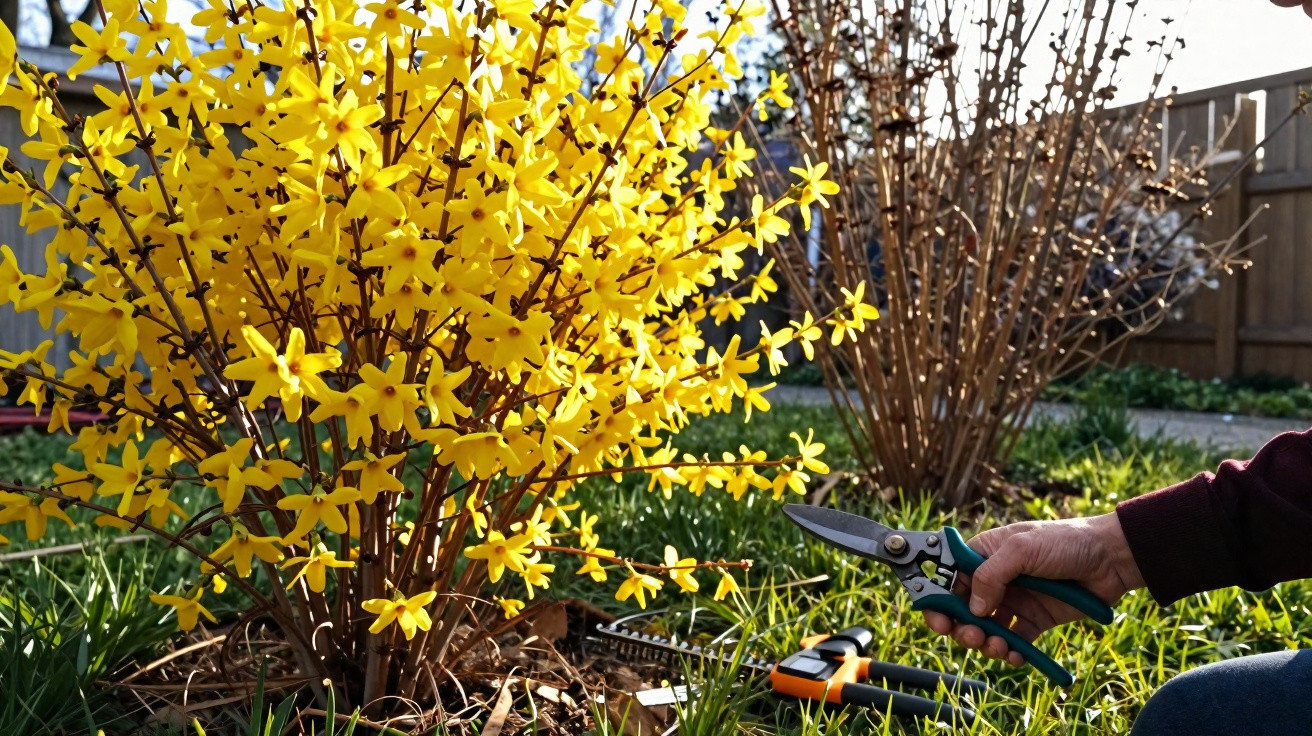
Standfirst: In March, many keen amateur gardeners reach for the secateurs with enthusiasm – and, without realising it, ruin the floral display of one of the most popular early-flowering shrubs.
As the days grow longer, gardeners are eager to tidy borders, trim hedges and prune shrubs. Yet this is precisely when a bright-yellow garden favourite is particularly likely to be cut at the wrong time – with serious consequences for both its flowers and its overall vigour.
Why pruning Forsythia in March is a serious mistake
This refers to Forsythia, which fills gardens with vivid yellow in late winter and early spring. Many people simply prune it along with everything else in March while they are shaping the garden. It may seem sensible, but horticulturally it is a clear error.
The reason is the way this shrub produces its flowers. Forsythia is a traditional spring-flowering shrub that forms its flower buds in the previous year. From June to August, it develops beneath its bark the buds that are intended to open the following spring.
Anyone using secateurs in March removes between 80 and 100 per cent of these fully formed buds. In other words, the shrub loses almost its entire season’s display before it has had any opportunity to show it.
“Pruning in March does not merely take away Forsythia’s current flowers; it weakens the shrub over time – long green shoots instead of cascades of yellow blooms are the direct result.”
The plant responds to the loss of wood with an emergency growth response: it directs its energy into vigorous new shoots that carry mainly leaves. This is a familiar sight in many front gardens: long, upright, pale-green stems, very few flowers, and a shrub that has lost its balanced shape.
Over time, repeatedly cutting it back at the wrong moment consumes a great deal of energy. The shrub becomes old and bare from the inside, flowers only slightly around the outside, and appears increasingly susceptible to disease.
The right time: when Forsythia can actually be pruned
The good news is that this damage can be avoided simply by changing the pruning date. The basic rule is straightforward: prune Forsythia only once flowering has finished. In other words, do not intervene before flowering, but immediately after it.
Depending on the region and weather conditions, this period usually falls between mid-April and mid-May. In cooler areas, it may be as late as the end of May. Watching the shrub matters more than following the calendar: once most of the yellow petals have fallen, the right time has arrived.
The same principle also applies to many other spring-flowering shrubs, including:
- Lilac
- Flowering currant
- Viburnum shrubs, such as the snowball viburnum form
- Weigela
All of these woody plants flower on shoots produced in the previous year. Cutting them back in March therefore removes the flowers that have already formed.
Three simple pruning rules for a richly flowering Forsythia
Once flowering is over, the real work can begin. The aim is not to make the shrub “small”, but to rejuvenate it and retain an open, natural shape. This can be achieved in three clear stages.
1. The one-third rule: selectively remove old shoots
First, take out the oldest and thickest stems. These are generally grey-brown, cracked and no longer growing strongly. The rule of thumb is:
- Cut out around one third of the oldest branches close to ground level.
Although this may look drastic, it gives the shrub room to breathe and allows young, vigorous shoots to develop.
2. Thin out the centre of the shrub
Next, turn your attention to the middle of the shrub. This is where dead twiggy growth, crossing branches and old, lifeless sections often accumulate.
- Remove wood that appears dead or shows no green layer when lightly scratched.
- Take away thin, weak shoots that would produce few, if any, flowers.
- Remove branches that cross or rub against one another to avoid damage.
This allows more light and air to reach the centre of the shrub. Fungal diseases and pests then have a much harder time establishing themselves.
3. Shorten faded flowering shoots selectively
Finally, lightly shorten the shoots that have just flowered. Ideally, reduce them by around 20 to 30 centimetres.
Important points:
- Always cut just above a pair of outward-facing buds.
- Preserve the shrub’s natural, slightly arching form.
This enables Forsythia to produce fresh flower buds on these shoots during summer, ready to create its vivid yellow display again the following spring.
“Three targeted steps – remove old branches, clear the middle of the shrub and shorten faded shoots – are enough to keep Forsythia flowering freely and growing vigorously for years.”
Other shrubs that should also be left alone in March
Forsythia is not the only shrub that can cause problems in spring. Many popular ornamental shrubs follow the same pattern, forming their flower buds in the previous year. Pruning them in March therefore also removes a large proportion of their blooms.
The following are particularly sensitive:
- Lilac: remove spent flower clusters by hand or shorten them lightly straight after flowering.
- Deutzia: shape it immediately after flowering, and never cut it back hard early in the year.
- Japanese kerria: thin out overgrown bushes after flowering, not in late winter.
- Certain hydrangea varieties that bloom only on old wood.
- Rhododendrons: remove faded flower heads by hand; carry out heavy pruning only in exceptional cases.
Remembering the simple rule, “prune spring-flowering shrubs only after flowering”, prevents the most common pruning mistakes in ornamental gardens.
Why an electric hedge trimmer does more harm than good
Another classic mistake is reaching for the electric hedge trimmer. Quickly clipping Forsythia into a perfect ball may sound practical, but this kind of “grooming” has major drawbacks.
A powered hedge trimmer cuts every shoot tip along the same line. As a result, the shrub branches only around its outer edge. A dense green shell develops, allowing very little light into the centre. Over the years, the inside becomes a genuine dead zone of old, bare wood.
The result is:
- hardly any flowers within the shrub
- a greater risk of fungal disease because of poor air circulation
- more pests in the dense, shaded areas
Anyone wanting a naturally grown shrub that flowers freely is better off using sharp hand secateurs or loppers. These make it possible to remove individual stems selectively at the base without shearing off the entire outer surface.
Practical tips: how to identify the right pruning approach
Many amateur gardeners are unsure when they can prune and when they should leave a shrub alone. A quick look at its flowering habit provides useful guidance. The following overview offers a broad framework:
| Flowering period | Pruning time | Examples |
|---|---|---|
| January to May | Immediately after flowering | Forsythia, lilac, deutzia, flowering currant |
| June to autumn | Late winter to spring | Butterfly bush, spiraea shrubs, many roses |
There is another useful indicator: if you are uncertain, prune less and observe the shrub for a year to see where it flowers. If blooms appear mainly on one-year-old shoots formed during the preceding year, it belongs in the “prune only after flowering” group.
What happens if you have already pruned in March?
Anyone who has already cut back their Forsythia heavily in March need not despair. Although the current season will have few flowers, the shrub can be rebuilt over the longer term.
The following steps are sensible:
- Leave the shrub to grow undisturbed for the rest of the year and do not prune it again.
- Only after the next, even if sparse, flowering period should you thin it out over several consecutive years using the method described above.
- Support it in spring with compost or a balanced organic fertiliser, without overdoing it.
With patience and a consistent, gentle approach to pruning, Forsythias recover remarkably well. Many older specimens produce a real firework display of flowers after targeted rejuvenation.
Why timing matters ever more when pruning the garden
Climate change is bringing many flowering and growing phases forward. What once began in April now starts in March in some areas. Anyone relying on the calendar alone can therefore easily get the timing wrong.
It is more helpful to look closely at the plants themselves: buds, flowers that have already opened and fresh shoot tips all provide clearer signals than a date. Using the faded yellow display as the guide for pruning Forsythia is more reliable, regardless of the year.
Those who see their garden as a long-term project think of pruning not only as tidying, but above all as a matter of rhythm and renewal. A few well-placed cuts at the right time often achieve more than any drastic spring trimming – and Forsythia repays this year after year with a yellow curtain of flowers that truly delivers what the shrub promises.















Comments
No comments yet. Be the first to comment!
Leave a Comment