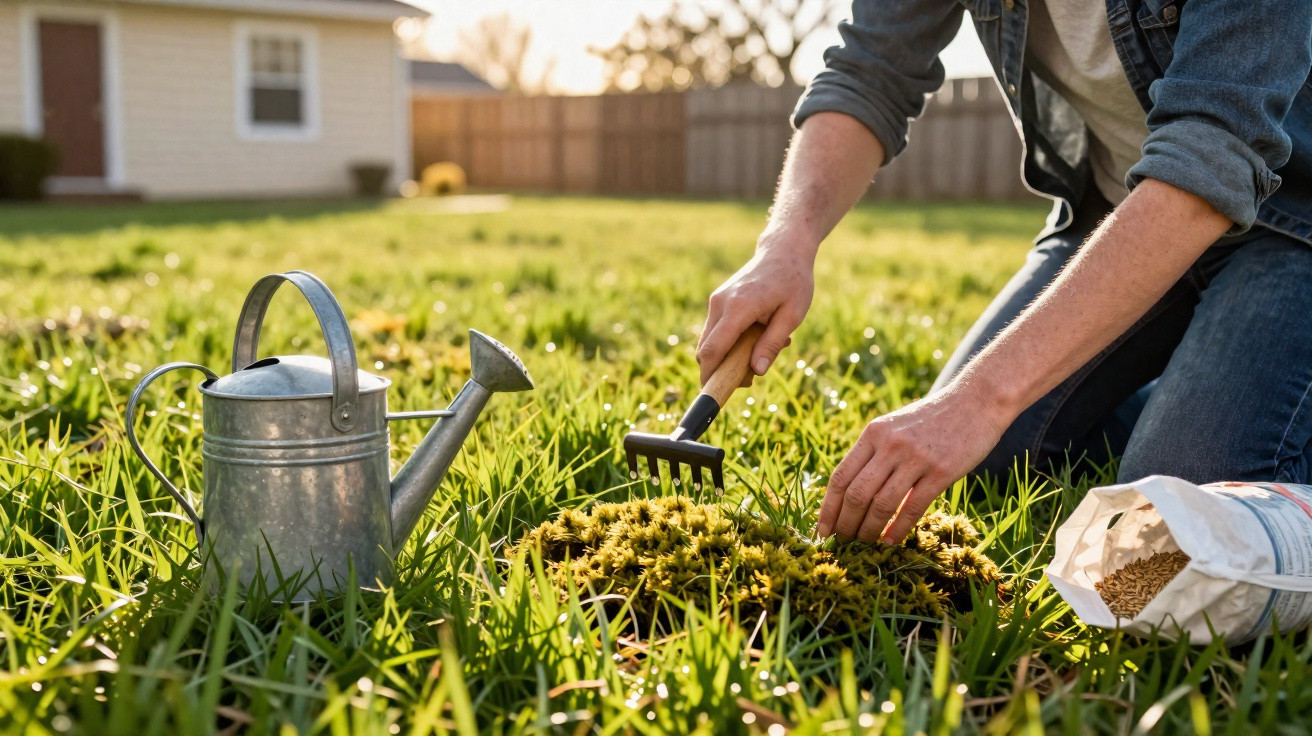
Act smart now and you can lay the groundwork for lush green grass right through to autumn.
Rather than spending money on costly specialist products, many experienced gardeners rely on three straightforward March jobs involving a rake, fork and lawnmower. Timing is crucial, as is knowing what moss in a lawn is really telling you.
Moss in the lawn is a warning sign, not the enemy
A lawn covered in moss after winter is really asking for help: the soil is exhausted, compacted and often overly wet. Moss thrives where grass struggles, including in waterlogged, shaded and nutrient-poor conditions.
Moss nearly always indicates that the soil is too wet, too compacted and receiving too little air.
Grass needs soil that is well aerated and free-draining. Over time, rainfall, regular foot traffic and tangled roots compact the ground. Water then cannot drain properly, while air has difficulty reaching the roots. These are ideal conditions for moss but poor ones for lawn grass.
The encouraging news is that targeted soil work in March can substantially reduce moss without using chemicals. Just three tasks can help the lawn grow more densely in spring and remain clearer of moss.
Task 1: Aerate the lawn with a fork to break up compaction
The key March job is to loosen the soil. Professionals call this “aeration”. No specialist machine is necessary: an ordinary digging fork will do the job.
How to aerate your lawn properly
- Choose a dry day, but avoid one when the ground is bone dry.
- Push the fork tines around 8–10 centimetres into the soil.
- Gently lever the handle backwards to form small cracks and air pockets.
- Make the next insertion at intervals of roughly 15 centimetres.
Work especially carefully in places where puddles remain after rain or where the ground sounds “hard” beneath your foot. These areas are particularly compacted and need air.
The many small holes create air channels that allow excess water to drain away and oxygen to reach the roots.
For a larger lawn, you can hire a lawn aerator from a DIY store. A fork is entirely sufficient for small gardens, although it does require some time and a little physical effort.
Task 2: Light topdressing helps create a denser lawn
After aerating comes a stage that home gardeners often overlook: lightly covering the lawn with a loose soil blend, known as topdressing.
The ideal mix for healthy lawn soil
A light, free-draining blend is best, for example:
- 1 part sieved garden soil;
- 1 part coarse sand (building sand or river sand);
- 1 part mature, sieved compost or leaf mould.
If you do not have compost, coarse sand alone will still fill the holes and improve drainage. The important thing is that the material is loose and crumbly.
Spread the mixture thinly across the areas you have already pierced. Then use a stiff broom or yard brush to sweep it into the holes until they are largely filled.
This thin layer of soil improves the structure, encourages better drainage and also supplies the grass with nutrients.
The result is usually not immediate, but develops throughout the season: the soil becomes more receptive, the lawn grows back more evenly and bare patches fill in faster.
Task 3: Rake out moss thoroughly and mow correctly
Once the soil has been loosened and improved, it is time to tackle the moss. Vigorous raking allows light and water to reach the grass roots again.
Rake properly rather than scarifying blindly
For the first spring treatment, a sturdy leaf rake or wire rake is generally enough. Pull it firmly through the lawn. The aim is not to destroy every patch of moss, but to loosen the dense thatch layer made up of dead grass and moss.
Ideally, place the raked-out plant matter on the compost heap. The nutrients can then make their way back into the garden later.
Next comes the first lawn cut of the year. This is where many people make the same mistake by setting the mower too low. The grass is weakened after winter and aeration work, so cutting it severely at this point would be harmful.
- For the first cut of the year, set a mowing height of at least 4–5 centimetres.
- It is better to cut slightly too high than too short.
- In May, the height can gradually be reduced a little.
After vigorous raking, the lawn can look “thinned out” for a few days – that is precisely when it starts to grow back stronger and denser.
The right timing: why March matters so much
These three jobs only work well when undertaken at the right time. Ideally, the ground is no longer frozen, has dried out slightly and has begun to warm up. In mild areas, this may be as early as late February; in cooler regions, it is more likely to be mid to late March.
Important rules of thumb:
- Do not work on frozen ground.
- Do not aerate heavily saturated soil, as this will smear the soil structure.
- A dry afternoon is preferable to several wet days before and afterwards.
If you follow these conditions, the full treatment - aerating, topdressing, raking and mowing - can be completed in a single afternoon.
What to do after the March lawn treatment
The three tasks provide the foundation, but a dense lawn with little moss needs some attention throughout the year. Nutrient supply, suitable mowing and water management are particularly important.
Fertilise, but use restraint
A nitrogen-rich lawn feed in spring gives the grass a boost. Organic fertilisers also encourage active soil life, which reduces moss growth over the long term. A second, lighter application in summer is usually sufficient.
Lawn height and watering
A lawn that is cut too short leaves little room for error. A height of around 4 centimetres is a useful guideline for most domestic gardens. It can be a little longer in shaded or dry spots.
Water less often but more deeply. Frequent small amounts keep the surface damp, which moss enjoys while grass suffers. During dry spells, one long watering session each week is often enough.
Why moss is not always the enemy
One final point for perfectionists: a completely moss-free lawn is barely realistic in many gardens, nor is it necessarily required. Some moss will repeatedly appear beneath trees, in deeply shaded corners or on heavy soils.
If you do not want to keep resorting to chemical treatments in these places, it can be better to take a more tolerant approach. Moss simply replaces grass in difficult areas where grass does not grow happily. What matters is that the main areas remain dense and hard-wearing - and the three March tasks make a major difference to exactly that.
Making use of the short March window when the soil conditions are right lays the foundation for a lawn that not only looks good in summer, but also comfortably withstands everyday life with children, barbecues and sun loungers.













Comments
No comments yet. Be the first to comment!
Leave a Comment