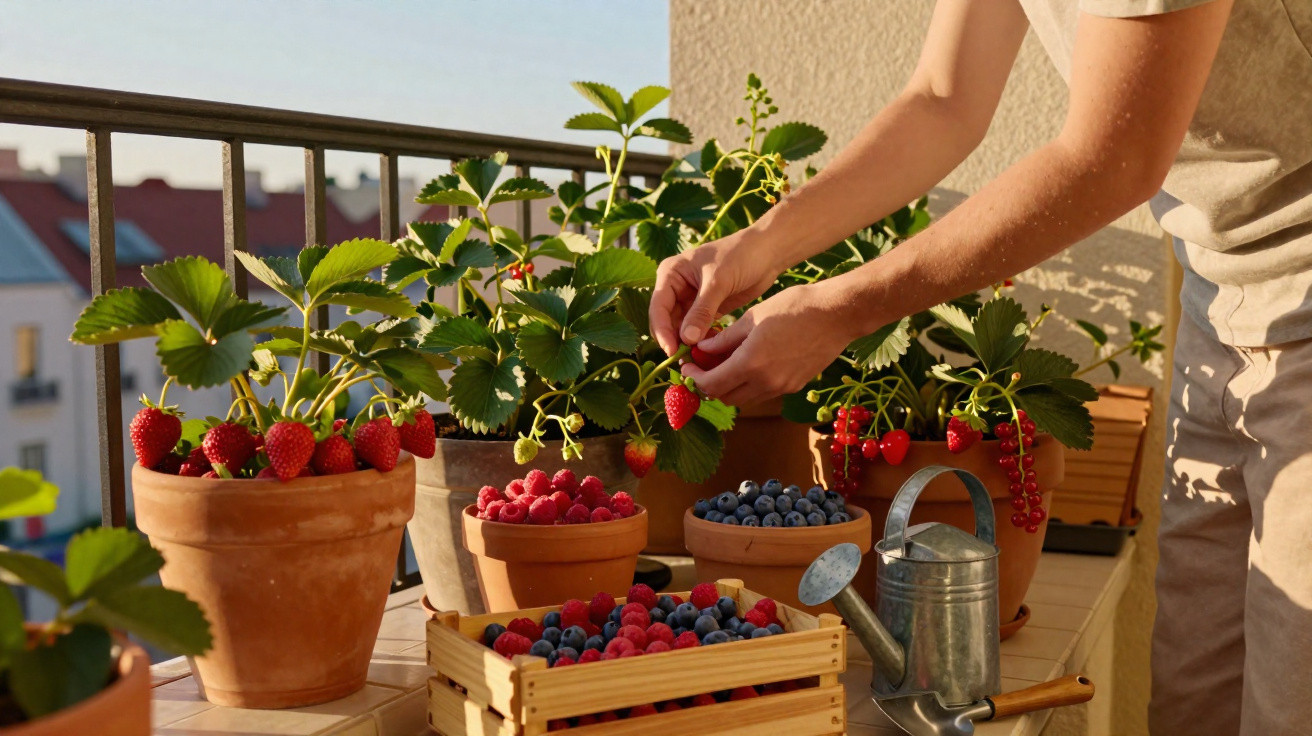
No garden is needed to grow your own fruit.
Just a few pots can turn a dreary balcony into a small, fruit-filled haven. With suitable berry varieties, this can happen surprisingly quickly. Some types stay compact, crop dependably and often perform better in containers than in a border. Choosing the right containers, a good growing medium and a well-planned watering routine is what matters. Within just one to two years, the first ripe fruits can be hanging right outside your balcony door.
Why berries thrive in pots
Many berry bushes develop fairly shallow root systems, making them well suited to tubs, window boxes and large planters. Pots allow you to manage the plant's environment precisely: airy compost, targeted feeding and controlled watering all help to produce strong, healthy plants.
“Berries in pots have a tailor-made home: plenty of air around the roots, controlled water and exactly the compost they need.”
Containers are movable too, which is another advantage. When the summer sun is too intense, a pot can be shifted into a slightly sheltered corner. If plants need more light, the container can be moved back to the front edge of the balcony. Even more sensitive varieties, such as blueberries, are easy to manage in this way.
The risk of disease is lower as well. Plants are less exposed to rain, foliage dries more quickly, and fungal spores spread less readily between plants. This helps reduce powdery mildew and similar problems without immediately resorting to sprays.
Watering: the most common balcony mistake
Watering is nearly always the biggest challenge when growing in pots. Compost warms up more quickly than garden soil and consequently dries out fast, particularly on hot, windy days. Unsure of what to do, many amateur gardeners alternate between conditions that are “almost desert” and “completely waterlogged”.
A consistent routine works best: water deeply, then allow the compost to dry a little, rather than giving frequent small amounts. Waterlogging is harmful, especially for fruiting plants. Water left permanently in a saucer causes roots to rot and results in a poor crop.
- Create a drainage layer of expanded clay or gravel in the pot.
- Use high-quality compost that retains its structure.
- Never water so late that the pot stays soaking wet overnight.
- On hot days, water in the morning and, if needed, again in the early evening.
Strawberries and dwarf raspberries: sweet classics for small spaces
Strawberries: an easy place to start
Strawberries are often a gardener's first experience of producing food on a balcony, and they are particularly rewarding. They grow vigorously in containers 20 to 25 centimetres deep, with around 10 litres of capacity per plant, and usually produce their first fruits in the year they are planted.
A simple growing medium is enough: roughly half multipurpose compost and half mature compost, over a 3 to 5 centimetre drainage layer of expanded clay. A sunny position and regular watering are essential; in summer, watering two to four times a week can be appropriate, provided no water is left standing in the saucer.
“At best, growing strawberries on a balcony means having a few sun-warmed fruits within reach every morning.”
Ever-bearing varieties, which keep producing flowers and berries over many months, are especially appealing for balconies. Trailing strawberries are ideal for window boxes or hanging baskets: the fruits hang freely, are less likely to rot and can be picked easily.
One important care tip is not to allow runners (stolons) to grow unchecked. They “use up” energy that would otherwise go into flowers and fruit. Remove most runners early on. After three years, it is worth renewing the plants with young ones, as yields generally decline by then.
Dwarf raspberries: a generous crop without a thorny thicket
Dwarf raspberries solve the classic garden problem of metre-high canes that flop over, tangle and prick. Compact varieties remain much smaller, fit well in deep containers and are often thornless.
A container 30 to 40 centimetres deep with a capacity of at least 15 litres is ideal. The compost should be loose, slightly acidic and free-draining; in most cases, a mix of multipurpose compost and compost works well. Once fully established, a dwarf bush can yield a surprisingly large number of fruits after a few years.
These plants enjoy sunshine, but will also tolerate a partially shaded balcony if it is not exposed to draughts. Water regularly without allowing persistent wetness. Pruning is needed once a year, usually towards the end of winter. Which canes should be removed depends on whether the variety fruits once or several times a year. As a rule, remove old canes that carried berries the previous summer, while retaining young, vigorous canes.
Blueberries, redcurrants and blackcurrants
Blueberries: demanding plants with special compost that are worth it
Blueberries are considered somewhat “fussy”, but their needs are straightforward to meet in pots. The key requirement is an acidic, peat-free specialist compost, such as that sold for ericaceous plants. The container should be 30 to 40 centimetres deep and hold approximately 20 to 30 litres.
Keeping two plants in separate pots is sensible. This improves pollination and often results in larger fruit that ripens more evenly. Choose a position with gentle sun, rather than intense heat throughout the afternoon, and use soft watering water that is low in lime wherever possible.
“Those who give their blueberries suitable compost and low-lime water are usually rewarded with a plentiful crop from surprisingly small bushes.”
Dwarf varieties remain especially compact, making them well suited to narrow balconies. With a little patience, the first worthwhile harvests begin after two to three years. Light pruning after fruiting, removing old and weak shoots, helps keep bushes vigorous for a long time.
Redcurrants and blackcurrants: vitamin-rich fruits for partial shade
Those with an east- or north-east-facing balcony do not have to miss out on berries. Redcurrants and their darker relatives cope extremely well with partially shaded corners. They prefer cooler conditions and can also tolerate some wind.
Use sturdy pots measuring 30 to 50 centimetres across, with a capacity of around 20 to 30 litres. Fill them with loose multipurpose compost mixed with plenty of compost. A mulch layer of bark pieces or shredded twigs protects against moisture loss and keeps the roots pleasantly cool.
With regular watering, the bushes establish reliably and form increasing amounts of fruiting wood over the years. A light shaping prune at the end of winter, thinning out the bush, allows plenty of light into the centre and promotes healthy leaves and clean fruit clusters.
- Redcurrant: fairly sharp, ideal for jellies and cakes
- Whitecurrant: milder, and decorative in fruit salads
- Blackcurrant: intensely flavoured and very rich in vitamins
Planning your mini fruit balcony
Four large pots are enough to create a surprisingly productive “mini fruit garden”: one container of strawberries, one pot for a dwarf raspberry, plus one container each for a blueberry and a redcurrant. Anyone with more space can double up on selected varieties to increase the harvest.
| Berry | Pot size | Position | First harvest |
|---|---|---|---|
| Strawberry | approx. 10 litres per plant | sunny | from the 1st year |
| Dwarf raspberry | at least 15 litres | sunny to partially shaded | from the 2nd year |
| Blueberry | 20–30 litres | bright, gentle sun | 2nd–3rd year |
| Redcurrant | 20–30 litres | partially shaded | from the 2nd year |
What many balcony gardeners underestimate
Berries in pots require regular feeding; otherwise, leaves become pale and berries stay small. From spring onwards, an organic berry fertiliser applied every two to four weeks supports growth. If compost is available, work a thin layer into the pot compost in spring.
Winter protection is another important consideration. Although these plants are generally hardy, roots in pots are far more exposed to cold than those in the ground. Several layers of horticultural fleece or hessian around the container, wooden blocks or polystyrene beneath the pot, and a little brushwood over the compost all help prevent frost damage.
Finally, variety selection makes a major difference. Not every garden variety is automatically suitable for a container. Labels stating “compact growth”, “suitable for patios” or “container growing” indicate that a plant is likely to cope well with limited space.
Once you have held your first bowl of mixed balcony berries, you will usually be planning the next season while enjoying it. What starts as a “trial in a pot” quickly becomes a regular project, along with an ever-improving feel for watering, fertiliser and the perfect spot.












Comments
No comments yet. Be the first to comment!
Leave a Comment