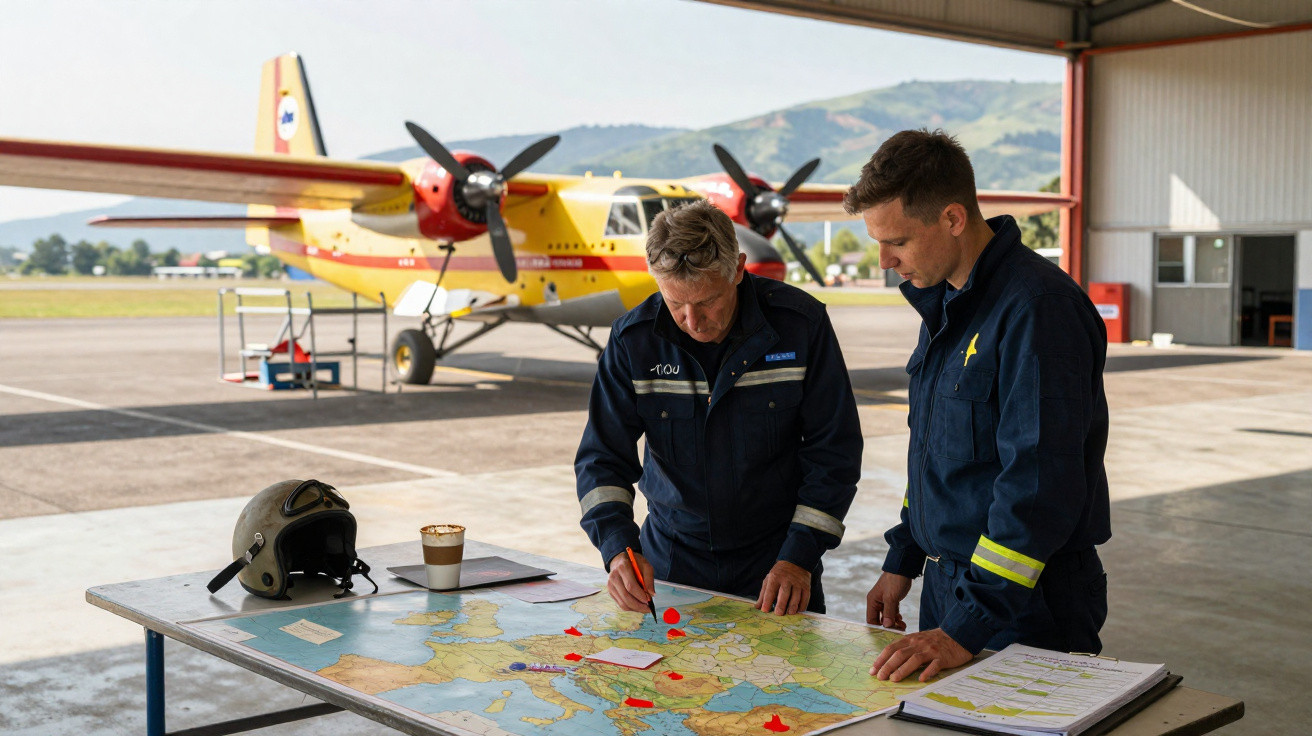
One million hectares went up in smoke in 2025, fire seasons now stretch across the entire year, and water-bomber fleets have never faced such intense demand. Europe is burning the candle at both ends.
In 2025, 1.03 million hectares of forest were destroyed by flames across the European Union. This is an all-time high since modern records began, and a perverse consequence of climate change, which is turning European summers into furnaces. Spain lost almost 400,000 hectares, with Portugal and Romania not far behind. Even Sweden saw its burned area rise by more than 120% above its recent reference average. Wildfires are spreading, precisely as climate models had, regrettably, predicted.
Equally foreseeable was the intolerable sluggishness of Europe’s institutional response to this crisis. A report commissioned by emergency aviation services operator Avincis was presented at the international aerial firefighting conference in Rome, and it makes for infuriating reading. Europe is not merely unprepared to defend the forests it still has: worse still, the report’s three stated causes were all avoidable.
Global firefighting fleets are reaching their limits
Aerial firefighting emerged during the 1950s, initially in the United States and Canada, using converted military aircraft. The first of these were Second World War B-17 bombers, stripped of their bomb loads and filled with fire retardant. France did not adopt the approach until 1963, following the recommendation of Jean-Émile Vié, Marseille’s deputy prefect, who believed Canadian methods could be used in Provençal forests.
Six decades on, firefighting bombers have evolved, yet they remain bound by the same economic constraint. Because they are enormously expensive to build, they cannot simply remain on the ground when there are no fires to tackle; they must therefore be kept in use as much as possible.
This is why aircraft rotation between the Northern and Southern Hemispheres was established. As early as 1986-1987, Canadian operators such as Conair were arranging the first seasonal aircraft transfers between Australia and North America. When it is summer in Europe and North America, Australia is in winter, and the reverse also applies. This made it possible to move aircraft according to the needs of each geographical area - a model now under severe threat.
Climate disruption has extended wildfire seasons worldwide so dramatically that the transfer window between the two hemispheres, previously just a few weeks, is closing a little more every year. In Australia, fires can rage until May; in Europe, they may start in April; while major fires have already broken out in the United States in December and January, including those in Los Angeles last year.
Australia, Europe and North America are therefore competing for the same aircraft at the same times. “The window for moving aircraft from one hemisphere to the other is narrowing, mechanically reducing the available global fleet,” says John Boag, Avincis’s chief executive. This trend was already outlined in the IPCC’s earliest reports at the beginning of the 2000s, which foresaw worsening wildfire risks: what, exactly, were governments doing in the meantime?
Water bombers do not grow on trees
With mounting pressure on global fleets, the obvious response would be to build more aircraft. The European Union has finally accepted this: in 2024, it released €600 million to purchase twelve DHC-515s, the successor to the Canadair CL-415, manufactured by De Havilland Canada. Unveiled at the Farnborough Airshow in August 2022, the aircraft was presented as the long-awaited answer to renewing Europe’s increasingly ageing fleet. The difficulty is that deliveries are scheduled between 2027 and 2030: impeccable timing, isn’t it?
A water bomber is an exceptionally complex aircraft to develop, while flight certification can take years, so the production line has to run with Swiss-watch precision. De Havilland Canada, the leading Western manufacturer of heavy amphibious firefighting aircraft, is now swamped with orders it cannot fulfil in time. Its chief executive, Brian Chafe, addressed the issue in the Avincis report: “We are trying to open a second production line, but government bureaucracies are extremely slow. And this is not unique to our aircraft: it applies to any firefighting equipment.”
As a reminder, the CL-415 made its first flight in 1993, and Europe only began seeking a replacement 30 years later. It cannot be said that Europe rushed into it.
The pilot shortage Brussels allowed to worsen
These water bombers need pilots, and in this respect Europe starts with a disadvantage largely of its own making. In the United States and Australia, aerial firefighting has long been a structured profession, with specialist schools and an air-operations culture for wildfire response dating back to the 1950s. A foreign pilot wishing to work there needs to pass one or two validation examinations.
According to Reuters, however, a foreign pilot hoping to work in the European Union must pass more than a dozen examinations to obtain a licence from the European Union Aviation Safety Agency (EASA), compared with one or two in the United States or Australia.
As though fires on European soil were more difficult to fight than those in the Australian bush or California’s mountains. Those are the rules, and in Europe the rules are not debated, even when the continent’s most precious ecosystems are under threat.
Just when they are needed most, we are consequently facing a pilot shortage - again, something that was entirely foreseeable. Experienced Australian and American pilots, trained on the same aircraft, are being prevented from working because they have not completed EASA’s twelve examinations. It is absurd.
The overall picture is far from encouraging when these three factors are considered together, and none of them suggests anything genuinely positive for the years ahead. There is, nevertheless, one small reason for hope: Hyanero, a French start-up backed by Airbus and newly boosted by a record €117 million funding round, is currently developing a next-generation water bomber (see the X post above). Yet it will not take flight until 2031… That means waiting five years without any certainty that the project will ever truly succeed, however much we hope it does. Europe will have to make do with what it has: somewhat worn aircraft operating through increasingly difficult-to-cover cycles above a continent that breaks wildfire records every year while remaining the champion of administrative delay.












Comments
No comments yet. Be the first to comment!
Leave a Comment