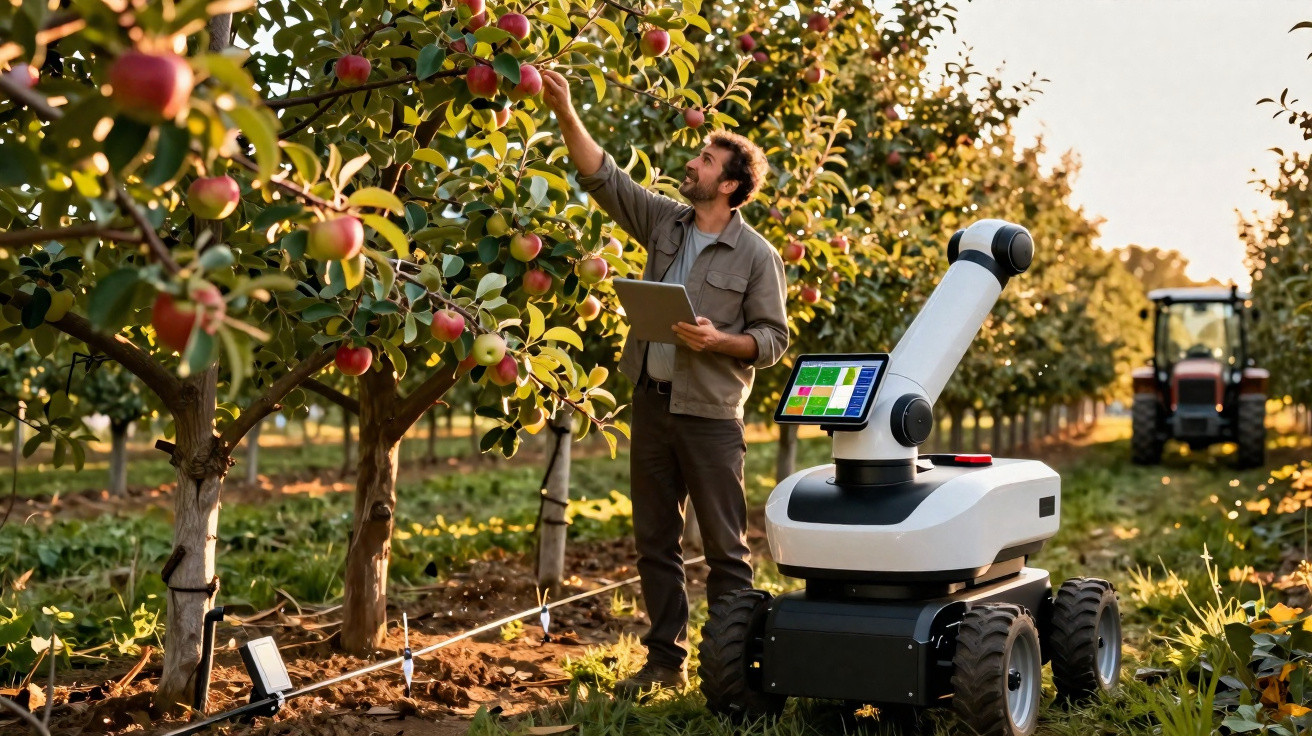
Researchers say a strawberry-picking robot that uses air to move leaves out of the way before reaching for berries improves harvesting success in real-world fields.
The advance brings one of agriculture’s most delicate tasks nearer to mechanisation, although human pickers remain quicker.
How the robots work
In outdoor strawberry beds, ripe berries are frequently concealed beneath leaves, restricting a machine’s vision and its ability to reach the fruit.
Engineers at Washington State University (WSU) identified this obstacle and developed a robot that removes the blockage before attempting a pick.
Field trials found that the harvesting rate rose to 73.9% when the fan was used, compared with 58.1% without it.
Despite the improvement, harvesting a single berry still required around 20 seconds. That constraint keeps labour pressures central to the issue.
Labor gaps in agriculture
Farm labour across Washington declined by 23% between 2017 and 2022, while migrant labour fell by 37%.
The shortage is especially acute in orchards and berry fields, where ripe produce must be located, assessed and handled carefully.
“Hand harvesting costs a lot of money,” said Lav Khot, professor of precision agriculture in WSU’s Department of Biological Systems Engineering.
Such pressure explains why WSU is continuing to develop harvesting aids that ease the workload rather than waiting for a completely autonomous harvester.
Soft robotics in orchards
A separate WSU team created a soft, air-filled apple arm designed to operate near branches without rubbing against fruit.
Its lightweight fabric structure and gentle movement reduce the chance of bruising apples or damaging limbs.
Modern orchard rows, which are already trained into flatter walls, are well suited to this approach because their straighter spaces offer machines simpler routes.
Safety by itself will not resolve harvesting shortages, but it illustrates how orchard equipment is being redesigned with both workers and trees in mind.
Data guides decisions
Weather and crop information is important because AgWeatherNet enables farms to monitor conditions before robots or crews are deployed.
WSU’s AgWeatherNet converts readings from stations into tools that identify heat, frost, irrigation schedules and pest risk.
These tools use machine learning, software that detects useful patterns within large data streams, rather than relying solely on fixed rules.
More accurate local timing is significant for automation, since sending a machine out too early or too late can waste both labour and water.
Water follows sensors
At an orchard in Mattawa, central Washington, automated irrigation used 52.4% less water than a comparison block.
Growers achieved this by connecting soil, plant and weather data to schedules that automatically adjusted timing and water volume.
Even with the reduction, researchers found no evidence of tree stress and calculated improved water-use efficiency.
Robotics relies on the same flow of prompt information, as irrigation, cooling and harvest planning are closely connected.
Weather varies across fields
Conditions in one orchard block can warm or cool differently from those in the next, making farm-scale weather information important.
Growers refer to this as a microclimate – the weather within a very small area – and it determines when fruit experiences stress.
More localised information could allow forecasts to inform hectare-level decisions, enabling machines to focus on a vulnerable area rather than entire fields.
Accuracy at that scale could make automation workable, because farms seldom struggle or succeed in precisely the same way.
Humans stay central
No prototype in Washington is intended to replace crews entirely, and the best outcomes still result from combining machinery with people.
Workers continue to assess challenging fruit, move bins, oversee repairs and decide when a field is too complicated for software.
“The stress we used to have to grow things, I think AI can help to mitigate that stress on humans,” said Khot.
From that perspective, machines serve as partners that take away repetitive strain while human judgement remains in charge.
Speed stays hard
Berry picking remains much slower than the work of skilled human crews, particularly when fruit is hidden beneath irregular leaves.
Orchard robots encounter another source of delay, as each movement must avoid branches, trellis wires and surrounding fruit.
Mud, glare, wind and changing plant growth also take these systems beyond the controlled conditions of a laboratory.
Progress is likely to come through gradual reductions in repetitive tasks, rather than one machine suddenly performing every job.
Trust takes time
Growers do not take up new equipment simply because it succeeds once, and public universities must demonstrate its value repeatedly.
Field days, shared information and on-farm trials are important because farmers need to observe how tools perform through genuine seasons.
When it tests equipment alongside growers, WSU operates as a land-grant university, a public institution established to serve communities.
In the end, this consistent public-facing work may decide whether prototypes become everyday equipment or stay as demonstrations.
What changes now
The emerging picture across Washington is not of farms without people, but of farms where data and machinery take on repetitive strain.
As these tools become quicker and more localised, the key question is how much demanding manual work they can remove first.




Comments
No comments yet. Be the first to comment!
Leave a Comment